Risk Management and Position Sizing
The skill that keeps you in the game.
Risk management is the single biggest difference between traders who last and those who blow up. Protecting capital is not the cautious choice — it is the mathematically optimal one.
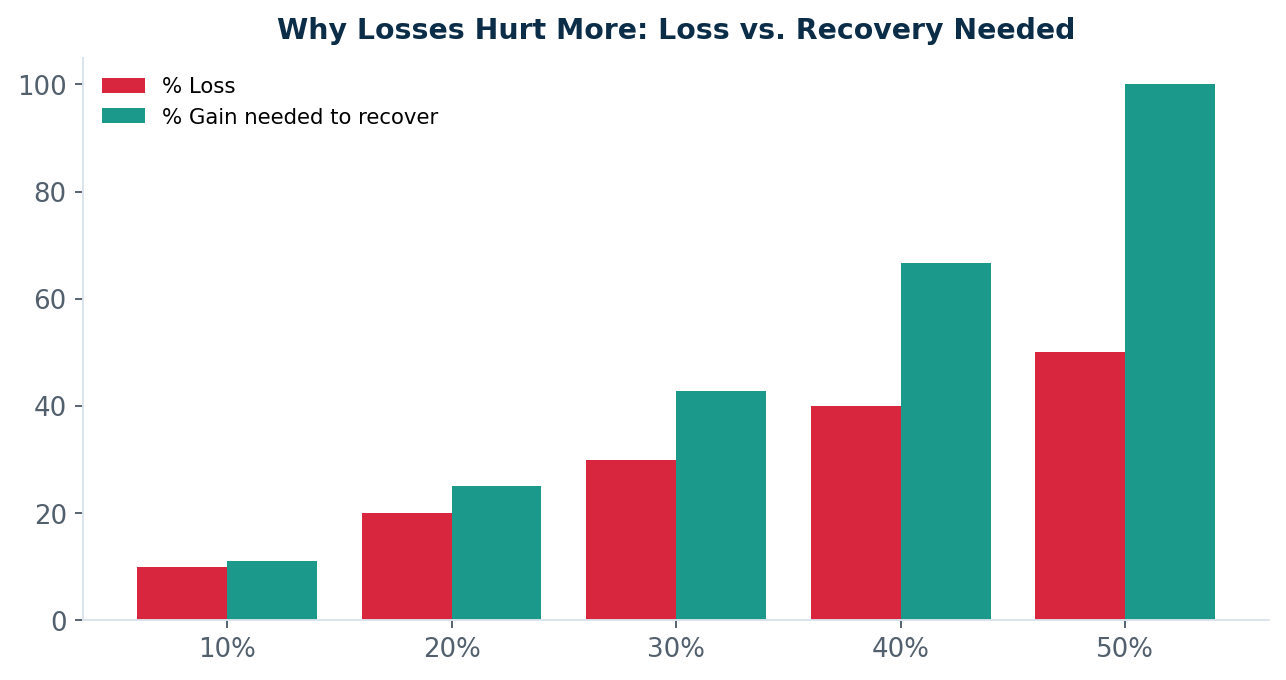
Losses and the gains needed to recover are not symmetrical — the deeper the loss, the disproportionately harder the climb back.
Why small losses matter so much
Lose 50% of your capital and you need a 100% gain just to break even, because you are now growing a smaller base. A 20% loss needs a 25% gain; a 50% loss needs a double. Capping losses while they are small is what keeps you in the game long enough for your edge to work.
| If you lose… | You need this gain to recover |
|---|---|
| 10% | 11% |
| 20% | 25% |
| 30% | 43% |
| 50% | 100% |
| 75% | 300% |
Position sizing: the core skill
Decide the rupee amount you are willing to lose on a trade first — commonly 1–2% of your capital — then size the position so that your stop-loss equals exactly that amount. Risk drives size, never the other way around. This one habit prevents the catastrophic single loss that ends most accounts.
The 1–2% rule in practice
Suppose your capital is ₹1,00,000 and you risk 1% per trade — ₹1,000. If your stop-loss is ₹5 below your entry, you can buy 200 shares (200 × ₹5 = ₹1,000 at risk). Change nothing about your view of the stock — the stop distance and your fixed risk decide the position size for you. This is how professionals make every loss survivable.
Diversify and respect correlation
Do not put all your capital into one stock or one sector. Spreading risk across several uncorrelated positions means a single bad outcome cannot sink you. Be aware that stocks in the same sector often move together — owning five bank stocks is far less diversified than it looks.
Set limits in advance
- Per-trade risk: a fixed 1–2% of capital, no exceptions.
- Daily loss limit: stop trading for the day once hit.
- Maximum open risk: cap the total you have at risk across all positions.
- Always use a stop-loss: a trade without one is a hope, not a plan.
GOLDEN RULE · Never move a stop away from price. You may tighten a stop to protect profit. You must never widen it to give a losing trade "more room" — that habit ends more accounts than any other.
Key takeaways
- Protecting capital is the mathematically optimal choice, not the timid one.
- Risk a fixed 1–2% per trade; let the stop distance set your position size.
- Diversify, and remember same-sector stocks move together.
- Always use a stop-loss, and never widen it to avoid a loss.
Ready to practise this? Open a Demat & trading account with Aditya Trading Solutions — low brokerage, pro charting, 24×7 support. More free guides at adityatrading.in/EBooks.
Educational use only. Published by ATS Share Brokers Pvt. Ltd. (SEBI Regn. INZ000205136). Not investment advice or a recommendation to buy or sell any security. Trading and investing carry a high risk of loss; patterns and strategies can fail and past performance does not indicate future results. Consult a SEBI-registered adviser before trading.
Frequently Asked Questions
A fixed 1–2% of your total capital is a widely used guideline. It keeps any one loss small and survivable.
Because you then need a 100% gain just to break even — you are rebuilding from a much smaller base. Capping losses early avoids this trap.
You may tighten it to protect profit as a trade works. You should never widen it to give a losing trade more room — that single habit ends many accounts.