Trading Psychology and Discipline
Mastering the mind behind the trades.
Two traders can run the same strategy and get opposite results. The difference is rarely the strategy — it is the mind operating it.
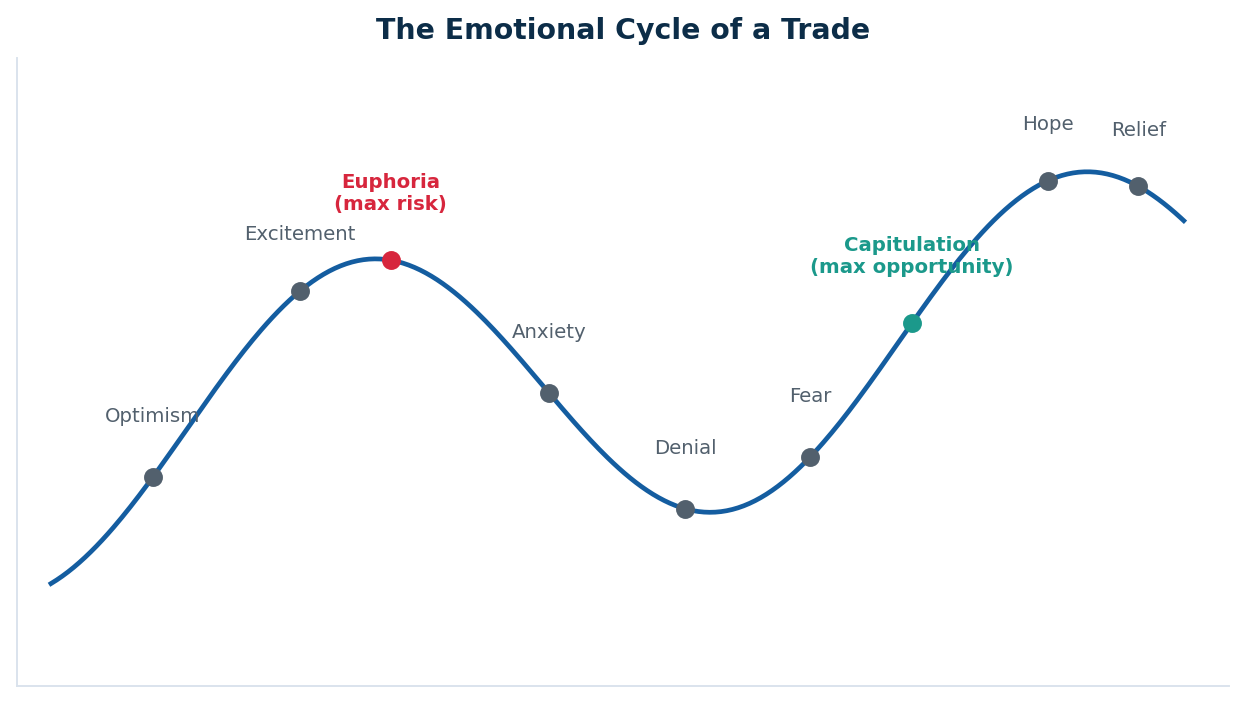
The point of maximum risk (euphoria) feels best; the point of maximum opportunity (capitulation) feels worst.
Feelings run opposite to reality
The emotional cycle is dangerous because confidence peaks exactly when risk is highest, and despair peaks exactly when opportunity is greatest. You cannot switch emotions off, but you can use them as a contrarian signal: when you feel invincible, check your risk; when you want to give up, consult your plan.
The biases that cost you money
- Loss aversion — holding losers and cutting winners early.
- FOMO — chasing a move that has already run.
- Confirmation bias — only seeing news that agrees with your position.
- Revenge trading — trying to win back a loss with a reckless trade.
Build discipline with systems
Willpower fails under stress; systems do not. Write a trading plan in calm moments, use a stop-loss and a daily loss limit, and keep a journal recording not just your trades but how you felt. Judge yourself on whether you followed your plan, not on any single outcome.
Build a routine that protects you
Discipline is a habit, not a personality trait. Before each session, review your plan and mark your levels. During it, take only the setups that qualify and journal as you go. Afterwards, review what you did against your plan, and weekly, read back your journal to find what your best and worst decisions had in common. This plan-execute-review loop is how amateurs become professionals.
The trading journal
A journal is the cheapest coach you will ever have. For every trade, record the setup and your reason, your stop and target, the outcome, whether you followed your plan, and how you felt. Over time the patterns become obvious: the setups that genuinely work for you, and the emotional states in which you make your worst decisions. You cannot improve what you do not measure.
Surviving a losing streak
Every strategy has losing runs — they are normal, not a sign you are broken. The professional response is mechanical: reduce position size, keep following your plan, and avoid the urge to "win it all back" with a reckless trade. Revenge trading after a loss turns a small, normal drawdown into a serious one.
KEY TAKEAWAY · Judge the decision, not the result. A good trade can lose and a bad trade can win. Over many trades, process — not luck — decides who profits.
Key takeaways
- The strategy rarely fails; the human running it does.
- Confidence peaks at maximum risk; despair peaks at maximum opportunity.
- Beat biases with systems: a written plan, stops, limits and a journal.
- Judge yourself on process, not on the result of any single trade.
Ready to practise this? Open a Demat & trading account with Aditya Trading Solutions — low brokerage, pro charting, 24×7 support. More free guides at adityatrading.in/EBooks.
Educational use only. Published by ATS Share Brokers Pvt. Ltd. (SEBI Regn. INZ000205136). Not investment advice or a recommendation to buy or sell any security. Trading and investing carry a high risk of loss; patterns and strategies can fail and past performance does not indicate future results. Consult a SEBI-registered adviser before trading.
Frequently Asked Questions
Because money triggers strong emotions in real time. The fix is systems, not willpower: a written plan, automatic stops, a daily loss limit and a journal.
Expect it — every strategy has them. Reduce size, follow your plan, and judge yourself on process rather than the outcome of any single trade.
Keeping a trading journal. It reveals which setups actually work for you and the emotional states in which you make your worst decisions.