Intraday Trading Strategies
Trading within the day with tight risk control.
Intraday trading means opening and closing positions within the same day, taking no overnight risk. It rewards speed, discipline and tight risk control.
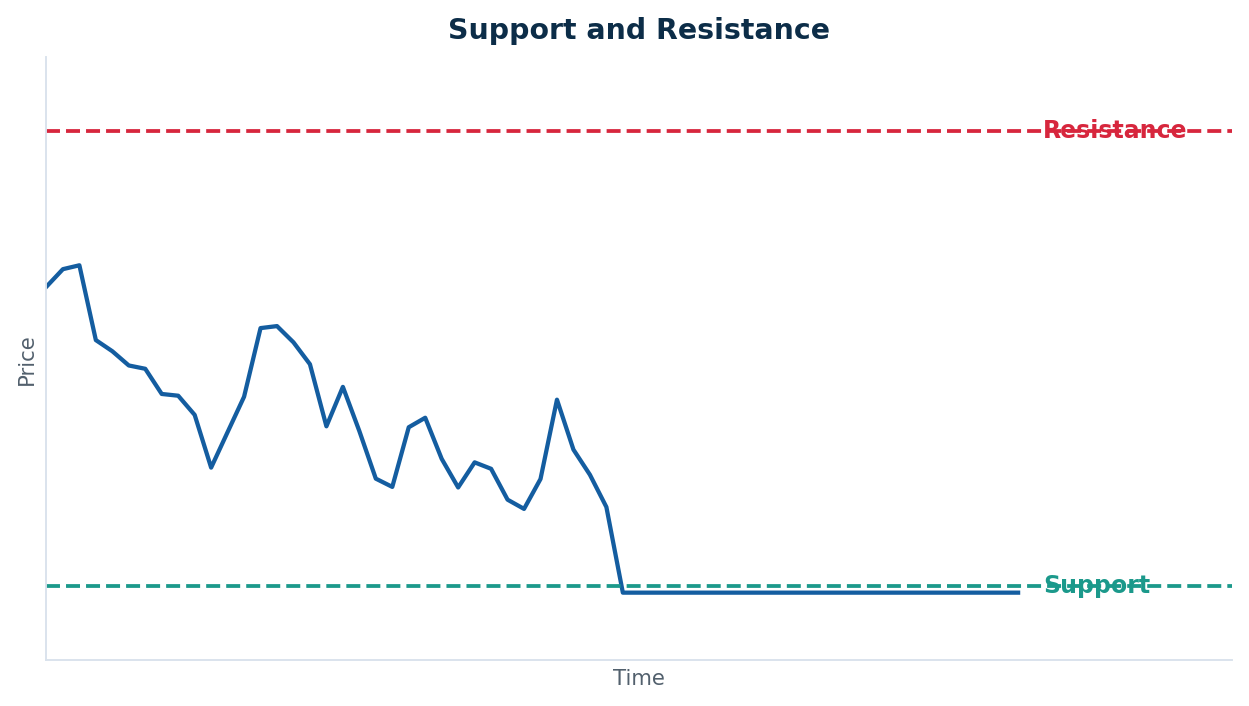
Intraday breakouts and ranges are read against the day's support and resistance levels.
How intraday differs
All positions are squared off before the market closes, so you avoid overnight gaps but rely on small, frequent moves. Intraday traders use leverage (margin), which magnifies both gains and losses, and they live on lower timeframes such as the 5-minute and 15-minute charts.
Three common strategies
- Breakout trading — enter when price breaks a clear support or resistance level on rising volume, riding the momentum that follows.
- Trend / pullback — in a trending day, buy small dips toward a moving average rather than chasing the highs.
- Range trading — on a quiet, sideways day, buy near support and sell near resistance, with tight stops just beyond the range.
Rules that keep intraday traders alive
| Rule | Why |
|---|---|
| Trade liquid stocks only | Tight spreads, easy entry and exit |
| Always use a stop-loss | Leverage turns small moves into big losses fast |
| Set a daily loss limit | Stops one bad day from becoming a disaster |
| Avoid the first 15 minutes | The open is volatile and noisy |
| Square off on time | Never let an intraday trade become an accidental hold |
A simple pre-market routine
Consistent intraday traders prepare before the bell. Check overnight global cues and any major news, mark the previous day's high, low and close as reference levels, build a short watchlist of liquid stocks that are in play, and decide in advance the levels at which you would act. Walking in with a plan beats reacting to every tick.
Discipline beats prediction
Intraday markets are fast and emotional, and leverage amplifies every mistake. The traders who survive are not the best forecasters — they are the most disciplined. Take only the setups on your plan, keep losses small and consistent, stop when you hit your daily loss limit, and review every session honestly. One well-managed losing day is recoverable; one undisciplined day can wipe out weeks of gains.
Indicators intraday traders watch
On fast timeframes a few tools dominate. VWAP (the volume-weighted average price) acts as a fair-value line many institutions trade around. Volume confirms whether a breakout has real force. Short moving averages highlight the intraday trend. As always, these confirm price — they do not replace a stop-loss.
WATCH OUT · Leverage cuts both ways. Margin can multiply gains, but it multiplies losses just as fast. Risk only a small, fixed percentage of capital per trade and respect your daily loss limit without exception.
Key takeaways
- Intraday means no overnight risk — but leverage magnifies every mistake.
- Trade liquid stocks, always with a stop-loss and a daily loss limit.
- Prepare a watchlist and key levels before the market opens.
- Discipline, not prediction, keeps intraday traders in business.
Ready to practise this? Open a Demat & trading account with Aditya Trading Solutions — low brokerage, pro charting, 24×7 support. More free guides at adityatrading.in/EBooks.
Educational use only. Published by ATS Share Brokers Pvt. Ltd. (SEBI Regn. INZ000205136). Not investment advice or a recommendation to buy or sell any security. Trading and investing carry a high risk of loss; patterns and strategies can fail and past performance does not indicate future results. Consult a SEBI-registered adviser before trading.
Frequently Asked Questions
It is the hardest style because of speed and leverage. Most beginners are better served learning on swing trades first, then moving to intraday with strict risk rules.
A small, fixed percentage — commonly 1–2% of capital — with a stop-loss on every trade and a hard daily loss limit.
The opening minutes are highly volatile and noisy, which produces frequent false signals. Many traders wait for the market to settle before acting.