Swing Trading Strategies
Capturing moves over days and weeks.
Swing trading captures moves that play out over several days to a few weeks — a middle path between fast intraday trading and long-term investing.
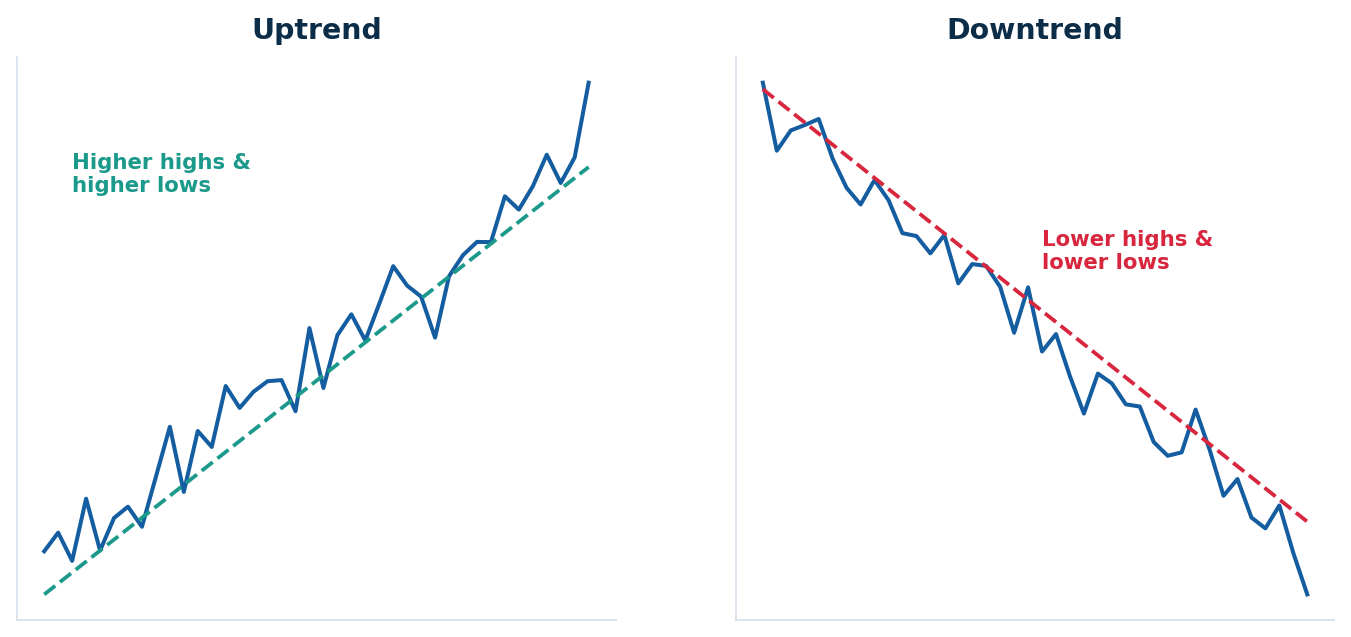
Swing traders ride the legs of a trend, buying dips in uptrends and selling rallies in downtrends.
Why swing trading suits most people
You do not need to watch the screen all day. Swing trades are typically planned on the daily chart and held for days or weeks, so they fit alongside a job. The trade-off is overnight risk: prices can gap on news while the market is closed.
A simple swing approach
- Find the trend on the daily chart — trade in its direction.
- Wait for a pullback to support or a moving average within that trend.
- Enter on a reversal signal — a bullish candlestick or pattern at the level.
- Set a stop below the recent swing low and a target near the prior high.
- Let it work — resist the urge to check every tick.
Managing the trade
Because swing trades are held longer, position sizing matters even more: size so that your stop-loss costs no more than 1–2% of your capital. Many swing traders trail their stop upward as the trade moves in their favour, locking in profit while giving the trend room to run.
A worked example
A stock has been in a steady uptrend for weeks and pulls back to a rising 20-day moving average that previously acted as support. At that level a bullish engulfing candle forms on rising volume. You enter as the next candle opens higher, place your stop just below the swing low, and set a target near the prior high — a setup offering roughly twice the reward of the risk. Whatever happens next, your downside is small and defined.
Common swing-trading mistakes
- Trading against the trend — the trend is your tailwind; do not fight it.
- Over-sizing — an overnight gap on a big position can do real damage.
- Moving the stop — widening a stop to avoid a loss turns a small, planned loss into a large one.
- Exiting winners too early — let the trend work; trail your stop instead of grabbing tiny profits.
Best conditions for swing trading
Swing setups work best in clearly trending markets, where pullbacks offer low-risk entries in the direction of the move. In choppy, directionless markets the same signals fail more often, so many swing traders simply trade less when no clean trend is present. Knowing when not to trade is part of the edge.
GOLDEN RULE · Plan for the gap. Holding overnight means accepting gap risk. Never risk so much on one swing trade that an adverse gap could seriously damage your account.
Key takeaways
- Swing trading captures moves over days to weeks and suits busy people.
- Trade with the trend; enter on pullbacks to support with a reversal signal.
- Size for overnight gap risk — never over-commit on one trade.
- Trail your stop to let winners run instead of exiting too early.
Ready to practise this? Open a Demat & trading account with Aditya Trading Solutions — low brokerage, pro charting, 24×7 support. More free guides at adityatrading.in/EBooks.
Educational use only. Published by ATS Share Brokers Pvt. Ltd. (SEBI Regn. INZ000205136). Not investment advice or a recommendation to buy or sell any security. Trading and investing carry a high risk of loss; patterns and strategies can fail and past performance does not indicate future results. Consult a SEBI-registered adviser before trading.
Frequently Asked Questions
Typically a few days to a few weeks — long enough to capture a meaningful move, short enough to avoid tying up capital for months.
Yes. Swing trades are usually planned on the daily chart outside market hours, which is why the style suits people who cannot watch screens all day.
Overnight gap risk — prices can jump on news while the market is closed. Keep position sizes modest so a single adverse gap cannot do serious damage.