1. What is Fundamental Analysis?
Fundamental Analysis is a method used to evaluate the financial and qualitative aspects of a business in order to estimate its intrinsic value. The goal is to determine whether a company's stock is fairly valued, overvalued, or undervalued in the market.
This approach is primarily used by long-term investors who want to invest in fundamentally strong companies with consistent earnings growth, low debt, healthy cash flow, and sustainable competitive advantages.
Purpose of Fundamental Analysis
- Assess the true worth of a company
- Make informed long-term investment decisions
- Identify opportunities where the market price differs from intrinsic value
Components of Fundamental Analysis
1. Quantitative Analysis
Based on financial data from annual reports and other company disclosures.
- Profit & Loss Statement – Evaluates revenue, expenses, and profitability
- Balance Sheet – Assesses assets, liabilities, and shareholder equity
- Cash Flow Statement – Tracks actual cash inflows and outflows
Example: Income Statement (in ₹ Crores)
| Particulars | FY 2022 | FY 2023 |
|---|---|---|
2. Qualitative Analysis
Focuses on non-financial factors that impact a company's performance:
- Business Model – Understanding how the company makes money
- Management Quality – Evaluating the experience and integrity of leadership
- Competitive Moat – Identifying barriers to entry or unique advantages
- Regulatory Environment – Analyzing how laws and policies affect operations
3. Macroeconomic and Industry Analysis
Evaluates external factors such as:
- Interest rates and inflation
- GDP trends
- Overall industry health
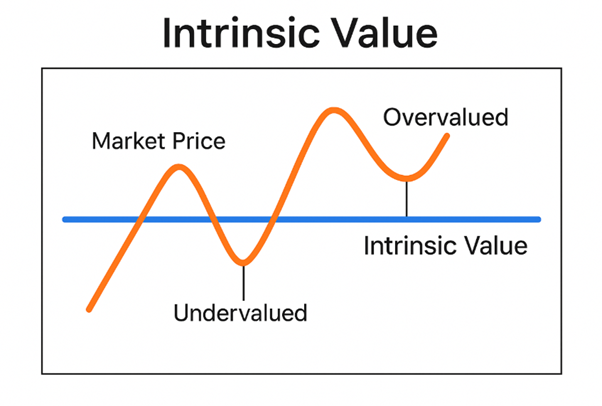
Intrinsic Value vs. Market Price
The core of fundamental analysis is to compare intrinsic value (what the company is truly worth) to the market price (what the stock is trading at).
- If Intrinsic Value > Market Price → Stock is undervalued, potential buy
- If Intrinsic Value < Market Price → Stock is overvalued, may avoid
Conceptual Graph:
Who Uses Fundamental Analysis?
- Long-term investors
- Portfolio managers
- Equity research analysts
- Value investors
These participants use this method to identify solid companies to hold for several years, not for quick profits from short-term market moves.
Limitations of Fundamental Analysis
- Time-consuming due to in-depth data requirements
- Relies on assumptions (e.g., future earnings projections)
- Market sentiment or external shocks may override fundamentals in the short term
Key Takeaways
- Fundamental analysis helps determine a stock’s intrinsic value
- Combines quantitative data (financial statements) and qualitative factors (management, business model, industry)
- Best suited for long-term investments, not short-term trading
- Compares intrinsic value with market price to spot undervalued or overvalued stocks
- Requires patience and discipline, but enables informed and rational investment decisions