12. What is Return on Equity (RoE), and Why is it Important?
Return on Equity (RoE) is one of the most important profitability ratios used in fundamental analysis. It measures how effectively a company uses the money invested by its shareholders to generate net profits.
Put simply, RoE answers the question:
“For every ₹1 of shareholder capital, how much profit did the company generate?”
It helps investors evaluate the financial efficiency of the business and the quality of its management, especially in terms of capital allocation.
Formula for RoE

- Net Profit (PAT): Profit after tax from the income statement
- Shareholders’ Equity: Includes equity share capital + reserves & surplus (from balance sheet)
Example
If a company has:
- Net Profit = ₹100 crore
- Shareholders’ Equity = ₹500 crore
Then:
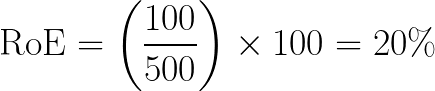
Interpretation:
The company generated a 20% return on the equity capital invested by its shareholders, which is considered strong.
Why RoE is Important
-
Measures Profitability on Owner's Capital
RoE focuses on returns for equity investors, making it highly relevant for shareholders and long-term investors. -
Assesses Management Efficiency
A consistently high RoE implies that the management is allocating capital efficiently—either reinvesting wisely or returning excess capital via dividends/buybacks. -
Helps in Peer Comparison
Comparing RoE across companies in the same industry helps identify businesses that are better at converting capital into profits. -
Supports Valuation Analysis
RoE is a key component in models like the DuPont Analysis and is often used with the Price-to-Book (P/B) ratio to gauge whether a stock is under- or over-valued.
Ideal RoE: How Much is Good?
- RoE > 15%: Generally considered good for most industries
- RoE < 10%: May indicate inefficiency or weak business fundamentals
- Extremely high RoE (>40%) may require scrutiny — could be due to low equity base or asset-light model
DuPont Analysis: Breaking Down RoE
RoE can be broken down using the DuPont formula:
RoE = Net Profit Margin x Asset Turnover x Financial Leverage
This helps analyze why RoE is high:
- High margins?
- Better asset efficiency?
- High debt?
Caution When Using RoE
- A high RoE driven by excessive leverage (high debt, low equity) may be risky.
- Comparing RoE across different industries can be misleading due to different capital structures.
- Look at sustainable RoE over several years, not just one-time spikes.
Key Takeaways
- Return on Equity (RoE) evaluates how efficiently a company uses shareholders' capital to generate profits.
- A higher RoE is generally desirable, indicating strong profitability and smart capital allocation.
- RoE helps in comparing peer companies, assessing management effectiveness, and guiding investment decisions.
- Investors should also look at RoE trends over time and in combination with other financial ratios.