12. What is 'Out of the Money' in Options?
In options trading, an option is considered Out of the Money (OTM) when it has no intrinsic value. This means that exercising the option at the current market price would not yield any profit for the option holder.
Although OTM options may have a market price (premium), this value is purely based on expectations of future movement in the underlying asset (time value and implied volatility). As expiry approaches, this time value erodes rapidly, and the OTM option tends to become worthless if the asset does not move favourably.
OTM Condition Based on Option Type
-
Call Option is OTM when the spot price is less than the strike price
The buyer has the right to buy at a price higher than the current market price. Since it is cheaper to buy directly from the market, there is no reason to exercise the option -
Put Option is OTM when the spot price is greater than the strike price
The buyer has the right to sell at a price lower than the market price. It makes more sense to sell in the open market, so exercising the option is worthless
Detailed Examples of OTM Scenarios
| Option Type | Strike Price | Spot Price | Intrinsic Value | Time Value | Status |
|---|---|---|---|---|---|
In both examples, the option has no intrinsic value. The buyer would not benefit from exercising it. The only value comes from the possibility that the market moves in their favor before expiry.
Characteristics of OTM Options
- Zero Intrinsic Value: OTM options are not profitable at the moment
- Lower Premium Cost: Premiums are lower compared to ATM and ITM options
- Purely Speculative: Traders buy OTM options expecting a strong market move
- High Risk – High Reward: Potential rewards are significant, but total premium loss is common
- Time Decay Pressure: As expiry nears, time value erodes quickly unless the market moves sharply
Real-World Analogy
Imagine you have a coupon to buy a laptop for ₹70,000. If the same laptop is sold in the market for ₹65,000, you would not use the coupon. That coupon is effectively worthless unless the price rises.
This is exactly how an OTM call option works. It gives you the right to buy at a higher price than the market, which makes no sense unless the market moves.
Premium Structure for OTM Options
OTM options consist entirely of time value. They have no intrinsic value until the market moves in the right direction.
| Option Type | Premium | Intrinsic Value | Time Value |
|---|---|---|---|
As expiry approaches, this time value declines — often reaching zero if the option remains OTM.
Visual Representation of Option Moneyness
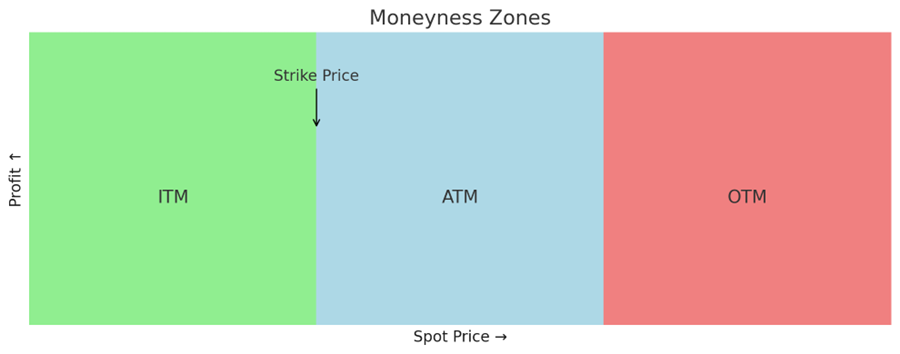
- ITM: Option is already profitable
- ATM: Break-even (spot = strike)
- OTM: Not profitable, may expire worthless
Comparative Overview: ITM vs ATM vs OTM
| Moneyness | Market Condition | Intrinsic Value | Premium Cost | Risk Profile | Exercise Worthy |
|---|---|---|---|---|---|
Strategic Use of OTM Options
- Buying OTM Calls in anticipation of a price breakout
- Buying OTM Puts before an expected crash or earnings disappointment
- Selling OTM Options (writing) for income strategies, benefiting from time decay
These options are attractive due to low upfront cost but require strong directional moves to become profitable.
Key Takeaways
- An option is Out of the Money when exercising it would not be profitable at the current market price
- OTM options have no intrinsic value; premiums are entirely time value and volatility-based
- They are speculative tools aimed at large potential returns from small investments
- If the market does not move, the OTM option expires worthless and the premium is lost
- Time decay works rapidly against OTM options, especially near expiry