4. What is a Put Option?
A Put Option is a derivative contract that gives the buyer the right (but not the obligation) to sell a specific quantity of an underlying asset (such as a stock, index, commodity, or currency) at a pre-decided price (known as the strike price) on or before a specific expiry date.
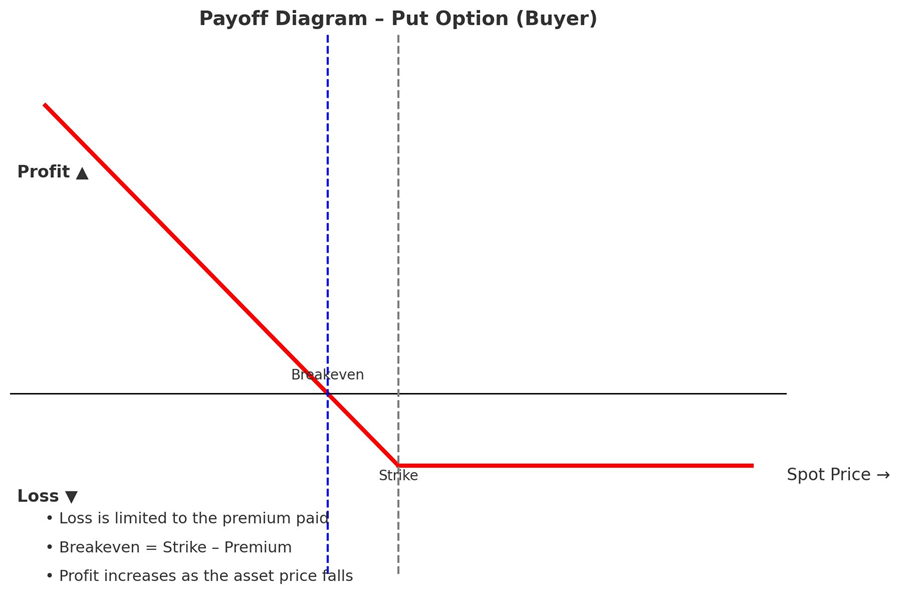
The buyer pays a premium to the seller for this right. If the market price of the asset falls below the strike price, the buyer of the put option can sell it at the higher fixed price, thus making a profit.
Purpose of a Put Option
Put options are mainly used for two reasons:
- Speculation – To profit from a decline in the price of an asset.
- Hedging – To protect a long position in a portfolio from falling prices.
It is a powerful tool for bearish traders or for investors who want to insure their holdings.
Real-Life Analogy
Think of a put option like insurance.
Example: If you own a car worth ₹10 lakh, you might pay ₹20,000 to insure it.
- If the car is damaged, the insurance company pays you.
- If it’s not damaged, you lose only the premium.
In the same way, a put option protects your stock from falling. If the market falls, the option gains in value. If the market rises, you lose only the premium paid.
Components of a Put Option Contract
| Component | Description |
|---|---|
Example – Buying a Put Option
- Expectation: Infosys stock will fall
- CMP: ₹1,500
- Put Option:
- Strike Price = ₹1,480
- Premium Paid = ₹20
- Lot Size = 300 shares
Scenario A – Stock drops to ₹1,420
- Sell at ₹1,480 (strike), Buy back at ₹1,420 (market)
- Profit per share = ₹60
- Total Profit = ₹60 × 300 = ₹18,000
- Premium Paid = ₹6,000
- Net Profit = ₹12,000
Scenario B – Stock stays above ₹1,480 (e.g., ₹1,510)
- Do not exercise → option expires worthless
- Maximum Loss = Premium Paid = ₹6,000
Payoff Analysis Table
| Infosys Price at Expiry | Action | Profit / Loss |
|---|---|---|
Breakeven Calculation
Formula:
Breakeven Point = Strike Price – Premium Paid
= ₹1,480 – ₹20 = ₹1,460
At ₹1,460, the profit from the option exactly offsets the premium paid — there is no net loss or gain.
When Should You Buy a Put Option?
| Market View | Action |
|---|---|
Key Benefits of a Put Option
| Benefit | Explanation |
|---|---|
Summary
- A Put Option gives the buyer the right to sell an asset at a fixed price.
- Used when a trader or investor expects the price to go down.
- Offers limited downside risk and potential for large profits in a falling market.
- Acts as a hedging tool to safeguard investments.