18. What Is the Impact of Inflation on G-Sec Yields?
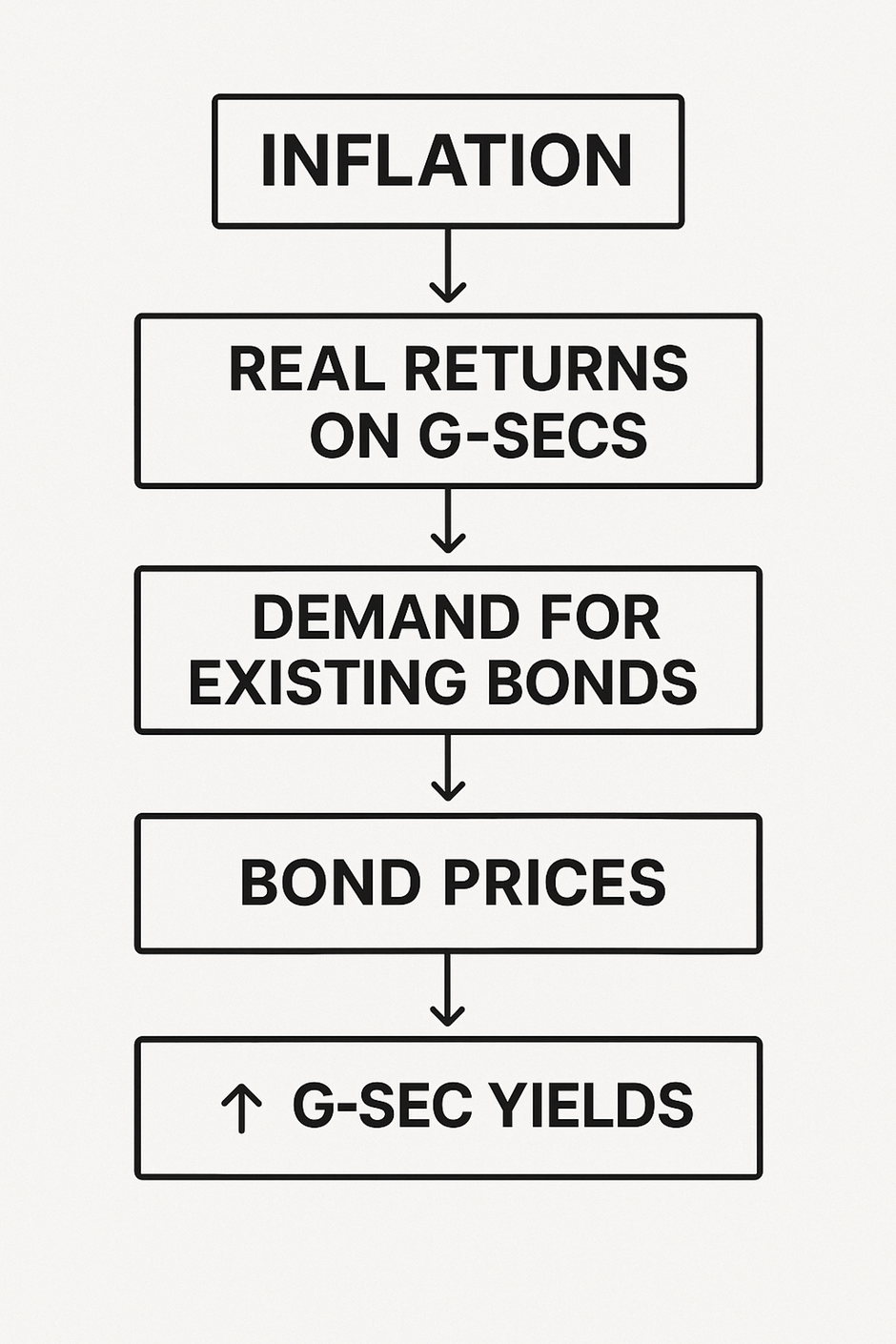
Inflation — the general rise in prices over time — directly affects the returns, demand, and pricing of Government Securities (G-Secs). Since G-Secs offer fixed interest payments, rising inflation erodes the real returns earned from these instruments, causing investors to seek higher yields as compensation.
As a result, there’s an inverse relationship between inflation and the price of G-Secs, and a direct relationship between inflation and G-Sec yields.
How G-Secs Work
- G-Secs are fixed-income instruments issued by the Government of India.
- Investors receive fixed coupon payments (interest) at regular intervals.
- The value of those fixed payments can be affected by inflation expectations.
What Happens When Inflation Rises?
1. Real Returns Decline
If inflation rises above the coupon rate, the real return (adjusted for inflation) turns negative.
Example:
- Coupon rate = 7%
- Inflation = 6%
- Real Return = 1%
But if inflation rises to 8%:
- Real Return = –1% → Loss in purchasing power
Investors Demand Higher Yields
To compensate for lower real returns, investors sell older G-Secs (with lower interest) and demand new bonds with higher interest rates.
This reduces the market price of existing G-Secs and increases their yield.
RBI Monetary Policy Tightening
To control inflation, the Reserve Bank of India (RBI) may raise the repo rate.
This makes borrowing costlier, reducing money supply, and also increases yields on newly issued G-Secs.
Impact Flow Chart
How G-Sec Yield Curve Shifts with Inflation
| Scenario | Yield Curve Behavior |
|---|---|
Role of Inflation-Indexed Bonds (IIBs)
To protect investors from inflation risk, the Government of India also issues Inflation-Indexed Bonds, where the principal and interest are linked to the Consumer Price Index (CPI).
These protect real returns during inflationary phases.
Real-World Example (India)
- Between 2022–2023, CPI inflation hovered above 6%, prompting RBI to raise repo rates.
- As a result, yields on 10-year G-Secs rose from ~6.5% to over 7.5%, reflecting investor expectations of higher returns.
Summary Table
| Factor | Effect on G-Secs |
|---|---|
Key Takeaways
- Rising inflation reduces the real return from G-Secs, making them less attractive.
- As inflation rises, investors demand higher yields, causing existing bond prices to fall.
- The RBI responds to inflation by raising policy rates, which in turn pushes up G-Sec yields.
- The yield curve shifts upward in inflationary conditions, especially for long-term G-Secs.
- Instruments like Inflation-Indexed Bonds provide a hedge against inflation risk.