20. Why Is Diversification into Currency, Commodity, and G-Secs Important?
Diversification is not just a strategy—it is a necessity for long-term investors seeking stability, resilience, and risk-adjusted growth. Equity markets, while offering high returns over time, are also susceptible to volatility, economic shocks, inflation risks, and geopolitical uncertainties. To protect a portfolio from such adverse scenarios, investors must diversify into non-equity asset classes such as currencies, commodities, and government securities (G-Secs).
The Core Idea of Diversification
Diversification involves allocating investments across different asset classes whose price movements are not closely correlated. This helps reduce portfolio volatility and protect capital in times of equity market downturns.
Let’s understand the role of non-equity assets in this strategy.
Role and Behavior of Key Non-Equity Asset Classes
| Asset Class | Function in Portfolio | Key Market Behavior |
|---|---|---|
Risk Reduction Through Uncorrelated Assets
Equities, currencies, commodities, and G-Secs often move independently. In adverse equity scenarios, other asset classes can help preserve capital.
Example:
- Equities may fall during a recession.
- Gold may rise due to its safe-haven demand.
- USD/INR may strengthen, benefiting currency traders.
- G-Secs may rally as interest rates are cut.
By combining these in a portfolio, the total drawdown is reduced, and recovery is faster.
Improved Risk-Adjusted Returns
Adding commodities, currencies, and G-Secs doesn't just reduce losses—it enhances risk-adjusted returns by delivering more stable performance across economic cycles.
| Portfolio Type | Annualized Return | Standard Deviation | Sharpe Ratio |
|---|---|---|---|
Even with slightly lower returns, the diversified portfolio delivers higher consistency and lower risk per unit of return.
Hedge Against Macroeconomic and Geopolitical Shocks
| Asset Class | Impact |
|---|---|
When one asset underperforms, others often outperform, providing a natural balancing mechanism.
Behaviour During Real-World Crisis Scenarios
| Crisis Period | Equity (Nifty 50) | Gold (MCX) | USD/INR | G-Secs (10Y Benchmark) |
|---|---|---|---|---|
As shown above, during major global crises, non-equity assets consistently outperformed equities, helping reduce losses and even delivering gains.
Scenario-Based Illustration: Diversified vs. Equity-Only Portfolio
Let’s look at the impact of a market downturn on two portfolios.
| Portfolio Type | Allocation | Performance During Equity Crash |
|---|---|---|
By allocating across asset classes, investors limit losses while maintaining exposure to growth.
Visual Flowchart: How Diversification Stabilizes the Portfolio
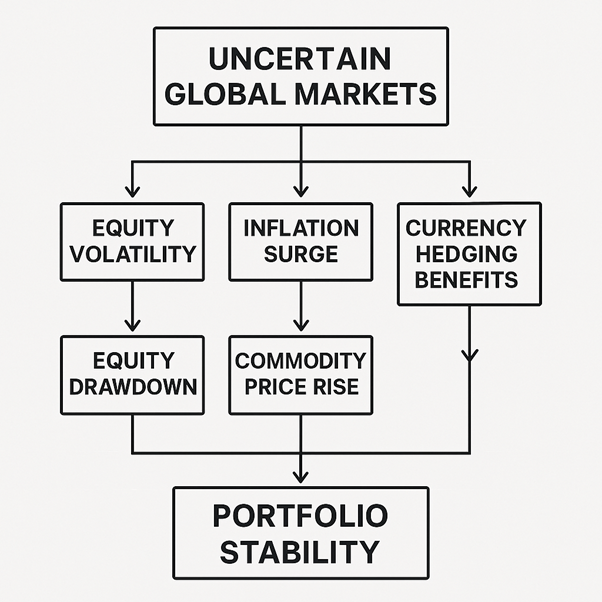
Long-Term Resilience and Compounding
G-Secs and commodities provide predictable returns and act as a buffer during periods of low equity growth. This allows compounding to continue without interruption, enhancing long-term wealth creation.
Annualized CAGR (2010–2024):
| Asset Class | CAGR |
|---|---|
A balanced mix of all four can deliver double-digit CAGR with lower volatility.
Regulatory Encouragement for Retail Diversification
Indian regulators like SEBI and RBI have simplified access to commodities, currencies, and G-Secs:
- Retail participation in G-Secs via RBI Retail Direct platform
- Currency and commodity trading through SEBI-registered brokers
- Taxation clarity on gains from non-equity instruments
- Reduced ticket sizes in bonds and commodity contracts
This makes it easier for individual investors to build multi-asset portfolios.
Key Takeaways
- Diversification is essential to protect capital and reduce volatility.
- Currency, commodity, and G-Secs behave differently from equities, making them powerful risk balancers.
- In down markets, these assets provide stability, act as hedges, and even offer gains.
- They improve the Sharpe ratio of your portfolio and allow consistent compounding.
- With simplified access and growing education, diversification is no longer just for institutions—every investor can and should adopt it.