7. What Are the Main Types of Commodities
Commodities are raw materials or primary goods that are either consumed directly or used to produce other goods. In the trading world, commodities are classified into two major categories — hard commodities and soft commodities — based on their source and nature.
This classification is essential for traders, investors, and producers, as it helps assess price behaviour, risk factors, and the global supply-demand impact differently for each type.
A. Classification of Commodities
| Type | Description | Examples |
|---|---|---|
1. Hard Commodities
Hard commodities are typically non-perishable and globally traded on futures exchanges. They are critical for industrial use, energy production, and wealth storage.
a. Metals
Used in industrial production and investment.
| Metal | Use Case |
|---|---|
b. Energy Commodities
Fuel global economic activity.
| Energy Source | Use Case |
|---|---|
These commodities are highly sensitive to geopolitical events, global demand, and OPEC policies.
2. Soft Commodities
Soft commodities are renewable and seasonal, often affected by weather, climate change, and planting cycles. They are crucial to global food supply chains and domestic economies.
a. Agricultural Commodities
| Commodity | Use Case |
|---|---|
b. Industrial Crops and Fibres
| Commodity | Use Case |
|---|---|
Soft commodities are heavily impacted by monsoons, harvest yields, pest attacks, and government MSP (Minimum Support Price) policies.
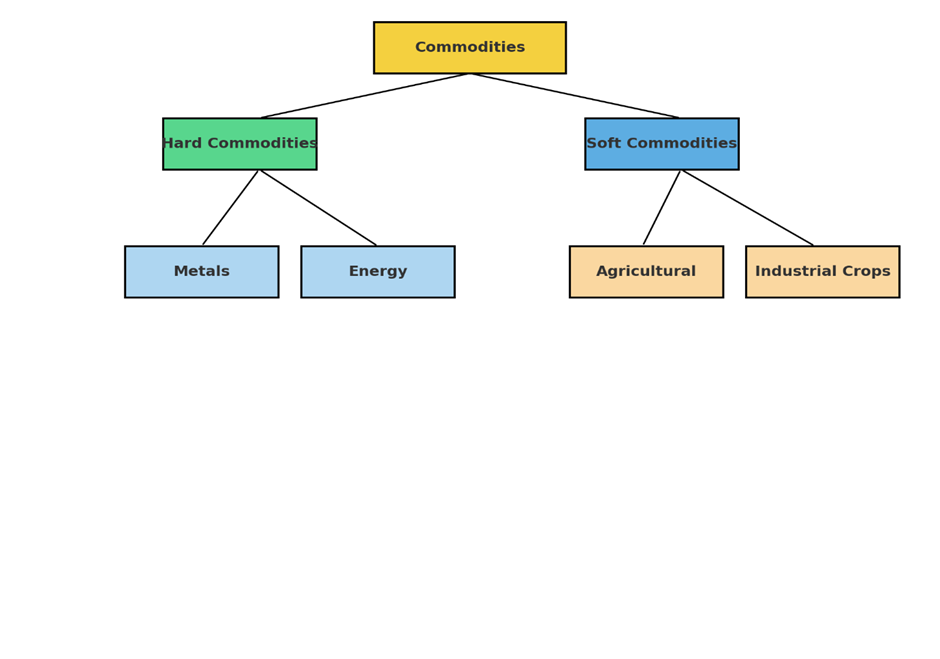
Visual Classification Chart
Market Behavior and Volatility
| Category | Nature of Price Movement | Key Influencing Factors |
|---|---|---|
Key Takeaways
- Commodities are classified as hard (metals, energy) and soft (agriculture, fibre, food)
- Hard commodities are extracted from the earth and widely used in industry and energy sectors
- Soft commodities are grown and are highly seasonal, depending on weather and agricultural cycles
- Understanding the type of commodity helps assess risk factors, volatility, and supply chain impacts
- These classifications are central to both commodity trading and economic planning in global markets