10. What is the Interest Coverage Ratio?
The Interest Coverage Ratio is a type of solvency ratio that measures a company’s ability to meet its interest obligations on outstanding debt using its operating profit or earnings before interest and taxes (EBIT).
In simple terms:
Interest Coverage Ratio answers:
“How many times can the company cover its interest expense with its operating income?”
This is a critical indicator for creditors, banks, bondholders, and investors to assess the company’s financial stability and creditworthiness.
Formula
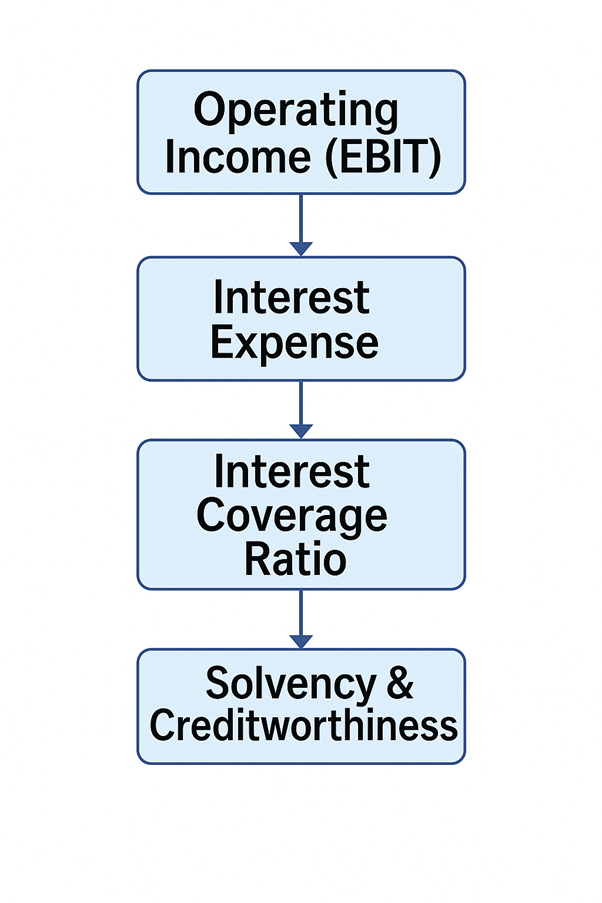
Interest Coverage Ratio = EBIT / Interest Expense
- EBIT (Earnings Before Interest and Taxes): Also known as operating income—profit before financing and tax expenses.
- Interest Expense: The cost incurred by the company for borrowed funds (loans, bonds, leases).
What It Indicates
| Ratio Value | Interpretation |
|---|---|
Example Calculation
Suppose a company has:
- EBIT = ₹60 crore
- Interest Expense = ₹15 crore
Interest Coverage Ratio = 60 / 15 = 4.0
Interpretation: The company can pay its interest expense four times over with its operating income — a strong sign of solvency.
Real-World Example (FY24 Estimates)
| Company | EBIT (₹ Cr) | Interest Expense (₹ Cr) | Interest Coverage Ratio |
|---|---|---|---|
- Infosys: No debt = no interest = no coverage issue.
- Tata Motors: Moderate buffer for debt servicing.
Visual Flow: How It Works
Why It Matters
| Stakeholder | Use of the Ratio |
|---|---|
Sector-Wise Expectations
| Industry | Typical Range | Comments |
|---|---|---|
Advantages of a High Ratio
- Financial flexibility during downturns
- Easier access to new credit or refinancing
- Lower cost of borrowing
- Higher investor confidence
Risks of a Low Ratio
- Liquidity crises during profit drops
- Risk of default and bankruptcy
- Poor credit ratings
- Restrictions from lenders (covenants)
Limitations
| Limitation | Reason |
|---|---|
Key Takeaways
- Interest Coverage Ratio measures how easily a company can pay its interest obligations using operating income.
- A higher ratio indicates financial strength and safety, while a lower ratio warns of debt servicing difficulties.
- Widely used by lenders, investors, and rating agencies to evaluate credit risk.
- Should be used alongside leverage ratios like Debt-to-Equity and Cash Flow to Debt for a complete picture.
- Varies significantly by industry and must be interpreted contextually.