11. What Are Valuation Ratios?
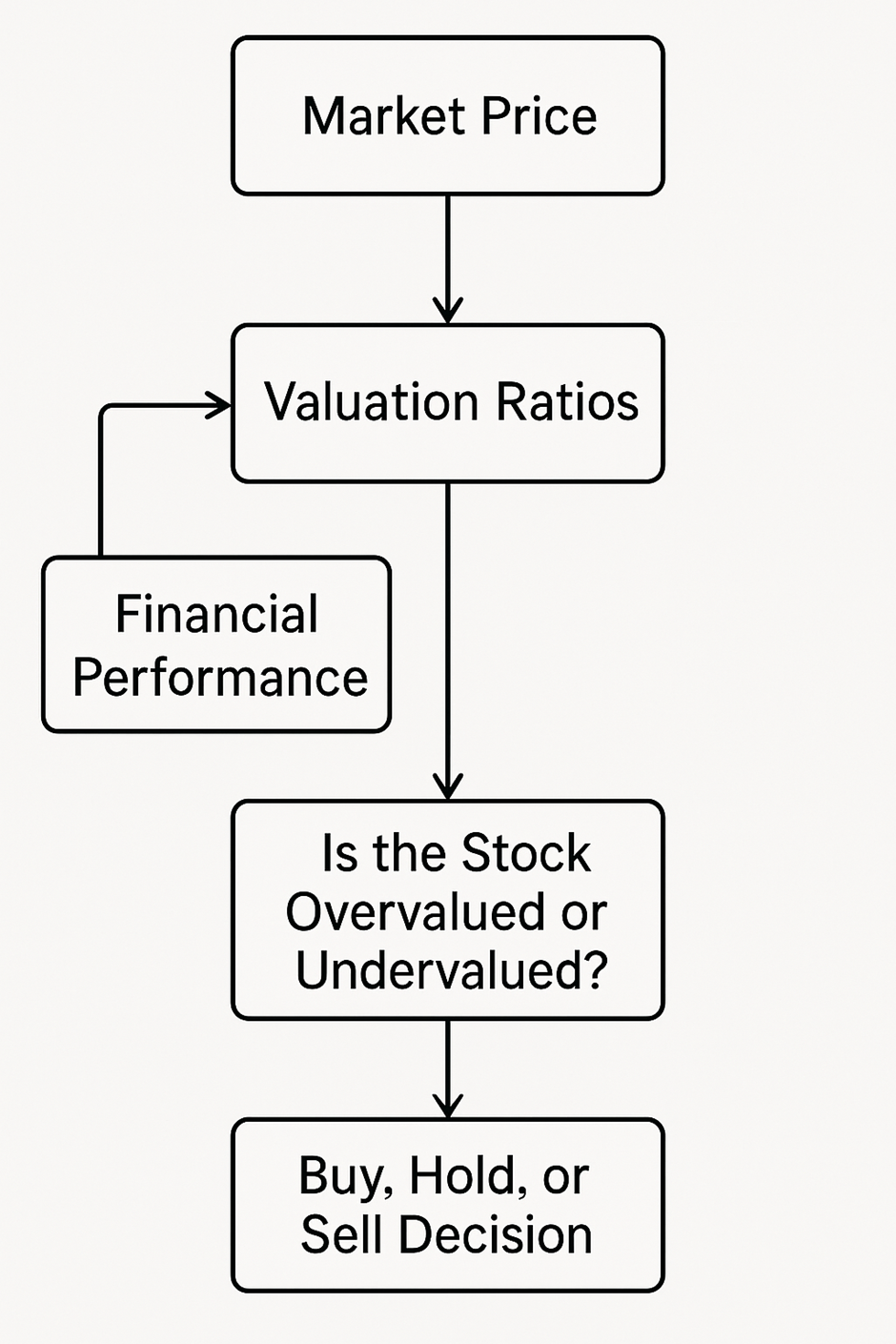
Valuation ratios are financial metrics used to assess the market value of a company relative to its financial performance, fundamentals, or assets. They help investors determine whether a stock is undervalued, fairly valued, or overvalued in relation to its earnings, book value, or cash flows.
These ratios are essential tools for:
- Stock analysts
- Portfolio managers
- Individual investors
They are commonly used in stock screening, fundamental analysis, and investment decision-making.
Why Are Valuation Ratios Important?
Valuation ratios answer the critical question:
“Is the stock price justified by the company’s financial strength and potential?”
They enable investors to:
- Compare companies within the same sector
- Identify undervalued opportunities
- Avoid overpriced stocks
- Justify long-term holdings
Common Valuation Ratios
| Ratio Name | Formula | What It Measures |
|---|---|---|
Interpreting Valuation Ratios
| Ratio | Low Value Means… | High Value Means… |
|---|---|---|
Example Comparison
| Company | PE Ratio | PB Ratio | EV/EBITDA | PEG Ratio |
|---|---|---|---|---|
- HDFC Bank appears more attractively valued than the IT stocks based on PE and PB.
- TCS commands a premium likely due to strong market positioning and brand.
Visual Flow: How Valuation Ratios Help Investors
Sector-Specific Benchmarks
Valuation ratios must be interpreted in context:
| Sector | Typical PE Range | Typical PB Range | Notes |
|---|---|---|---|
Limitations of Valuation Ratios
| Limitation | Explanation |
|---|---|
Key Takeaways
- Valuation ratios help determine whether a stock’s market price reflects its intrinsic worth.
- Key ratios include P/E, P/B, EV/EBITDA, PEG, and Dividend Yield.
- Always compare valuation ratios within the same industry or peer group.
- Use in conjunction with growth metrics, profitability ratios, and qualitative analysis.
- A low ratio doesn’t always mean “buy” and a high ratio doesn’t always mean “sell” — context is everything.