5. What is Return on Equity (ROE)?
Return on Equity (ROE) is one of the most widely used financial ratios by equity investors, analysts, and management to assess a company’s ability to generate profit from the money shareholders have invested. It directly tells you how much return a company is generating for its equity holders.
In essence:
ROE = “How many rupees of profit does the company make for every rupee invested by shareholders?”
A high ROE typically signals strong financial health, effective management, and shareholder-friendly operations.
ROE Formula
Return on Equity (ROE) = (Net Profit / Shareholders’ Equity) × 100
- Net Profit: Also known as net income or bottom-line profit after tax, interest, and all expenses.
- Shareholders' Equity: Total equity available to shareholders, including retained earnings and capital.
What ROE Tells You
ROE measures the efficiency with which a company uses its shareholders’ capital to produce net profits.
If a company has an ROE of 20%, it means it generated ₹20 in profit for every ₹100 of equity invested by shareholders.
Categories of ROE
| ROE Range | Meaning |
|---|---|
Example: How to Calculate ROE
Assume a company reports:
- Net Profit: ₹12 crore
- Shareholders’ Equity: ₹60 crore
ROE = (12 / 60) × 100 = 20%
This means the company earns ₹20 for every ₹100 invested by its shareholders.
What’s Included in Shareholders’ Equity?
| Component | Description |
|---|---|
Real-World Company Comparison (FY24 Estimates)
| Company | Net Profit (₹ Cr) | Equity (₹ Cr) | ROE (%) |
|---|---|---|---|
TCS shows a superior ROE, indicating highly efficient use of shareholder funds, driven by scalable operations and consistent profitability.
Why ROE Matters for Investors
| Benefit | Explanation |
|---|---|
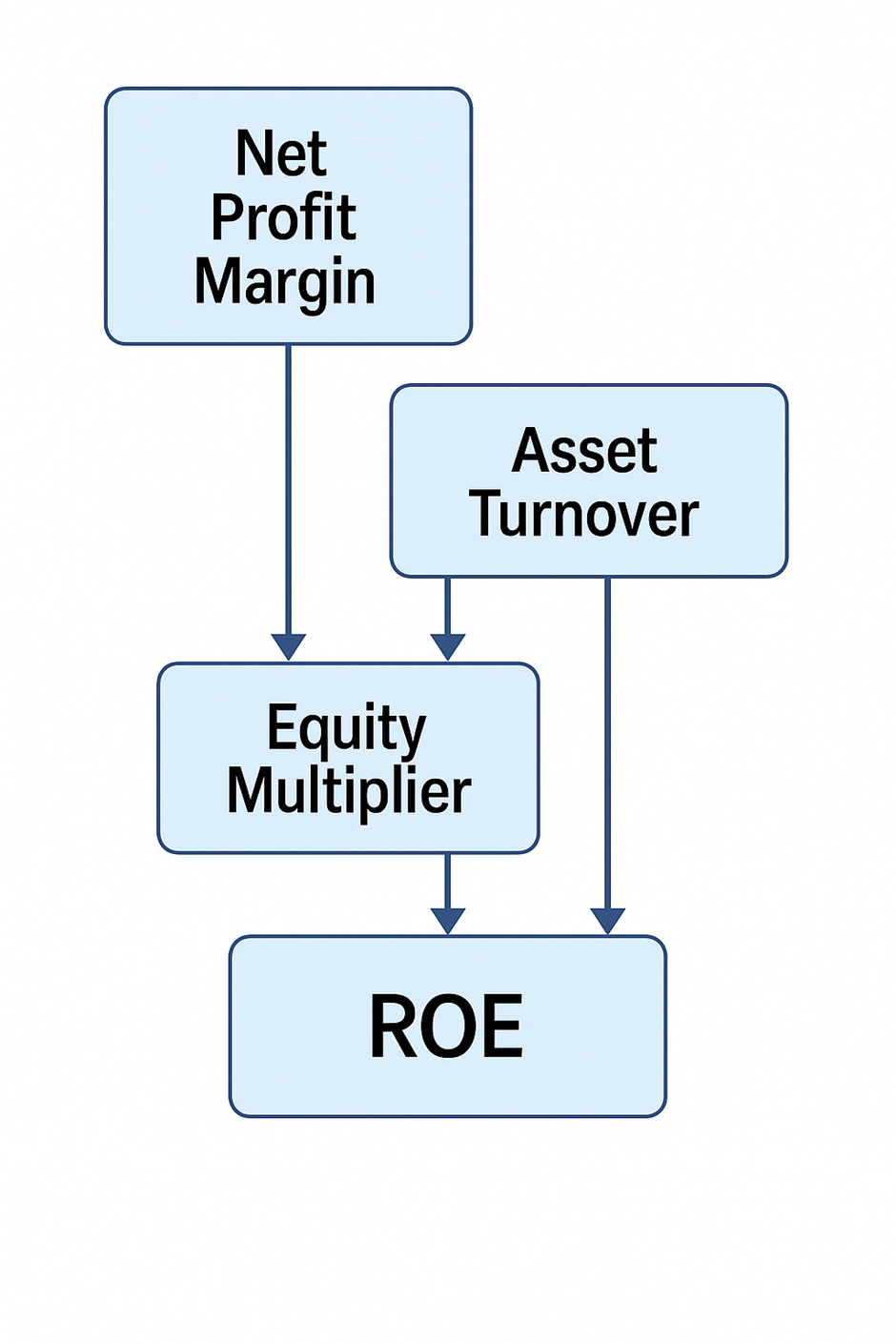
DuPont Analysis: Breaking Down ROE
To understand what’s driving ROE, analysts use the DuPont Formula:
ROE = Net Profit Margin × Asset Turnover × Equity Multiplier
| Component | Meaning |
|---|---|
DuPont ROE = Operational Efficiency × Asset Use Efficiency × Leverage
Key Scenarios
- High ROE with Low Debt
- Positive: Indicates a highly efficient and financially strong company.
- High ROE with High Debt (High Equity Multiplier)
- Warning: Profitability might be inflated due to debt. Could be risky.
- Declining ROE Over Time
- Red Flag: Could signal declining margins, rising equity base without proportional profit growth.
Limitations of ROE
| Limitation | Why It Matters |
|---|---|
Best Practices for Using ROE
- Compare ROE with peers in the same industry
- Track ROE trends over multiple years
- Use alongside ROA (Return on Assets) and ROIC (Return on Invested Capital)
- Examine DuPont components to avoid being misled by leverage-driven ROE
Key Takeaways
- ROE reveals how efficiently equity capital is used to generate profit.
- Higher ROE is typically better—especially if it's sustainable and not driven by high debt.
- Use DuPont Analysis to understand what's really driving ROE.
- It is a must-use metric when comparing profitability across companies from a shareholder’s lens.