Visit ATS Website
Go to adityatrading.in → Click Open Account.
Know the difference. Invest smarter.
They work hand in hand, but serve different purposes. Here's how they complement each other and why you need both for successful stock market investing.
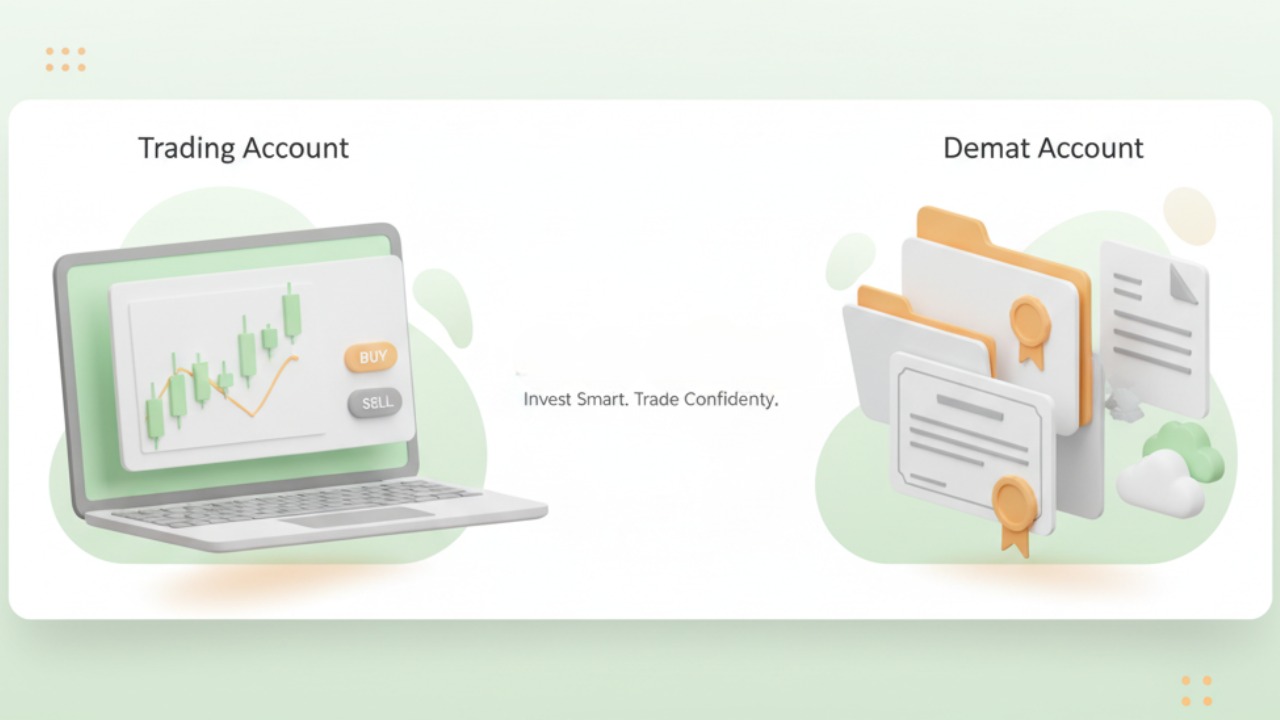
If you're new to stock market investing, you've probably heard the terms "Trading Account" and "Demat Account" used together — sometimes even interchangeably. But while they work hand in hand, they serve two very different purposes. In this comprehensive guide, you'll clearly understand the difference, why you need both to invest, and how Aditya Trading & Share Brokers (ATS) makes the entire process simple and seamless.
A Demat Account (Dematerialized Account) is used to store your investments in digital form — just like how your bank account stores money. Whenever you buy shares through the stock exchange, they are credited to your Demat Account. When you sell them, they are debited automatically.
In short: A Demat account is your digital locker for holding shares, bonds, ETFs, and mutual funds. Managed by national depositories like NSDL and CDSL through registered brokers such as ATS.
Example: You buy 10 shares of Infosys → They appear in your Demat account within 2 working days.
A Trading Account acts as the transactional bridge between your bank and Demat account. When you buy shares, the Trading Account debits money from your bank and credits shares to your Demat. When you sell, it debits the shares and credits money back to your bank.
In short: A Trading account is your gateway to the stock exchanges (NSE, BSE, MCX, etc.). Trades are executed here; holdings live in Demat.
Example: Place a buy order for Infosys → Trade executes via your Trading Account → Shares settle into your Demat.
| Feature | Trading Account | Demat Account |
|---|---|---|
| Purpose | To buy and sell shares | To store shares and securities |
| Functionality | Executes trades on exchanges | Holds securities electronically |
| Linked With | Bank & Demat Account | Trading Account |
| Issued By | Stockbroker (like ATS) | Depository participant (via broker) |
| Analogy | Shopping cart — where you buy/sell | Locker — where you keep purchased items |
| Example Action | Placing an order on NSE | Holding those shares after purchase |
Together, they complete the cycle of investing, storing, and trading securely in the Indian stock market.
Bank Account → Adds or receives money
Trading Account → Executes the buy/sell order
Demat Account → Stores or releases the securities

One-time setup connects Demat, Trading & Bank instantly

Save annual maintenance fees on your Demat account
Trade more at minimal cost with competitive brokerage

Get expert insights for informed trading decisions

Trade, track, and analyze — anywhere, anytime

Advanced encryption & 2FA for complete safety
Rahul decides to invest ₹5,000 in the stock market.
Technically, you can open a Demat account without a trading account (e.g., to hold mutual funds), but you can't trade shares without a trading account. For active stock market participation, both are mandatory. ATS offers a 2-in-1 account setup — combining both in a single application process for your convenience.
The Trading Account is your execution tool, and the Demat Account is your storage vault. Together, they create a seamless path to invest confidently in India's financial markets. With ATS, you can open both accounts online in minutes and start trading with professional insights, lowest brokerage, and top-tier customer support.
Get Started — Open Your Accounts Today