NSE IPO 2026: The ₹30,000 Crore Listing That Took 10 Years to Arrive
Executive Summary
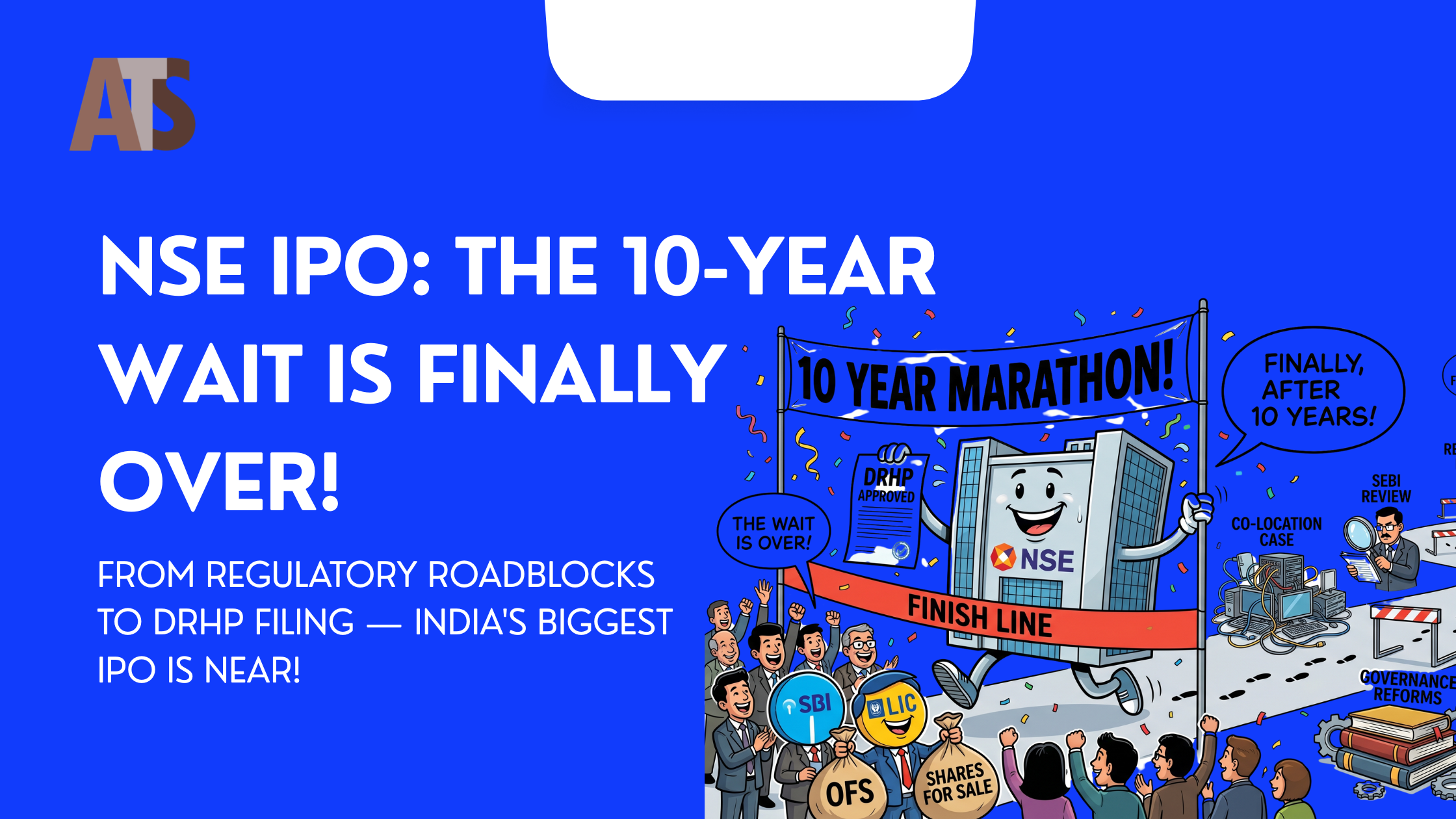
After nearly a decade of waiting, the National Stock Exchange (NSE) has finally filed its Draft Red Herring Prospectus (DRHP) with SEBI, paving the way for what could become the largest IPO in Indian history. The issue size is estimated at ₹30,000 crore, surpassing Hyundai India's ₹27,859 crore IPO and LIC's ₹20,557 crore IPO.
The filing marks the end of a long journey that began in 2016 and was delayed by regulatory investigations, governance concerns, and the infamous co-location controversy. )
NSE at a Glance
| Metric | Value |
|---|---|
| Founded | 1992 |
| IPO Filing | June 2026 |
| Estimated IPO Size | ₹30,000 Crore |
| Estimated Valuation | ₹5 Lakh Crore |
| Shares Offered | 14.89 Crore Shares |
| IPO Type | 100% Offer For Sale (OFS) |
| Largest Shareholder | LIC (10.72%) |
| Proposed Listing Venue | BSE |
| Global Ranking | World's Largest Derivatives Exchange by Trading Volume |
Why Did NSE Want to List in 2016?
Back in 2016, NSE was already India's dominant stock exchange.
The objectives were:
-
Unlock value for shareholders
-
Improve corporate transparency
-
Align with global exchange operators
-
Provide liquidity to investors holding unlisted shares
NSE filed its first IPO application on 18 October 2016. Investors expected the listing within months. Instead, the process got stuck for almost ten years.
What Delayed the IPO for 10 Years?
1. The Co-Location (Co-Lo) Scandal
This was the biggest hurdle.
What Happened?
Certain brokers allegedly received faster access to NSE trading servers through co-location facilities.
Even milliseconds matter in high-frequency trading.
SEBI believed some traders may have received an unfair advantage over others.
This triggered:
-
Multiple investigations
-
Regulatory actions
-
Court proceedings
-
Management changes
-
Governance reviews
The controversy became the primary reason SEBI withheld IPO approval.
2. Governance Concerns
SEBI raised concerns regarding:
-
Internal controls
-
Board oversight
-
Technology management
-
Compliance systems
-
Fair market access
Before allowing the country's largest exchange to list, regulators wanted assurance that governance standards met global benchmarks.
3. Technology Infrastructure Issues
SEBI also examined:
-
Server allocation mechanisms
-
Market data dissemination
-
Trading access architecture
-
Risk management systems
Given NSE's role as critical financial infrastructure, technology integrity became a major regulatory focus.
What Changed in 2025-26?
Major Regulatory Settlement
In 2025, NSE moved toward settling long-standing co-location and dark fibre cases.
Reports indicate settlement proposals exceeding ₹1,388 crore were submitted to SEBI.
SEBI's No Objection Certificate (NOC)
In January 2026, NSE received a significant regulatory breakthrough when SEBI granted permission to proceed with the IPO process.
Board Approval
NSE's board approved the IPO plan in February 2026.
DRHP Filing
Finally, on 17 June 2026, NSE filed the DRHP with SEBI.
How Big Is NSE Today?
The exchange is far larger than it was in 2016.
Financial Performance
FY24
-
Revenue from Operations: ₹14,780 crore
-
Total Income: ₹16,352 crore
FY25
-
Revenue from Operations: ₹17,141 crore
-
Total Income: ₹19,177 crore
FY26
-
Revenue from Operations: ₹16,601 crore
-
Total Income: ₹18,713 crore
Even after a slight moderation in FY26, NSE remains among the most profitable financial infrastructure businesses in India.
Structure of the IPO
Pure Offer For Sale (OFS)
One important point:
NSE will not receive any money from the IPO.
The IPO is entirely an OFS.
This means existing shareholders will sell shares and receive the proceeds.
Shareholders Selling in the IPO
State Bank of India (SBI)
Selling approximately 2.48 crore shares.
Other Major Sellers
| Shareholder | Shares Being Sold |
|---|---|
| SBI | 2.48 Cr |
| MS Strategic Mauritius | 1.60 Cr |
| CPPIB | 1.19 Cr |
| Aranda Investments | 1.12 Cr |
| Bank of Baroda | 1.10 Cr |
| Stock Holding Corp | 1.09 Cr |
| GIC Re | 1.07 Cr |
| New India Assurance | 1.05 Cr |
| National Insurance | 0.60 Cr |
| United India Insurance | 0.60 Cr |
LIC's Big Decision
The largest shareholder is:
LIC
Stake: 10.72%
Interestingly, LIC has chosen not to sell any shares in the IPO.
Many analysts interpret this as a sign of confidence in NSE's long-term value.
Expected Valuation
Current unlisted market estimates suggest:
| Metric | Value |
|---|---|
| Estimated Valuation | ₹5 Lakh Crore |
| Unlisted Share Price | ~₹2,045 |
| IPO Size | ~₹30,000 Crore |
At this valuation, NSE would immediately become one of India's most valuable listed financial companies.
Impact on the Stock Market
Positive Impact
1. Boost to Investor Sentiment
The successful listing of NSE would reinforce confidence in India's capital markets.
2. Wealth Creation for Existing Holders
Many institutions have held NSE shares for years.
Potential beneficiaries include:
-
SBI
-
Bank of Baroda
-
IFCI
-
IDBI Bank
-
Insurance companies
In fact, shares of several shareholder companies rose after the DRHP filing announcement.
3. Increased Transparency
Listed companies must disclose:
-
Quarterly earnings
-
Shareholding patterns
-
Corporate governance practices
-
Material developments
This improves accountability.
4. More Interest in Unlisted Market Investing
The success of NSE's listing could increase investor interest in:
-
Unlisted companies
-
Pre-IPO opportunities
-
Financial infrastructure businesses
5. Benchmark for Financial Infrastructure Companies
The IPO could become a valuation benchmark for:
-
BSE
-
CDSL
-
NSDL
-
Clearing corporations
-
Market infrastructure institutions
What Happens Next?
Step 1
SEBI reviews the DRHP.
Step 2
Observations are issued.
Step 3
Final prospectus is filed.
Step 4
Price band is announced.
Step 5
IPO opens for subscription.
Step 6
Listing on BSE.
Conclusion
The NSE IPO is not just another public issue.
It is the culmination of:
-
10 years of regulatory scrutiny
-
Governance reforms
-
Technology upgrades
-
Settlement of legacy disputes
-
India's rapid capital market growth
From an IPO proposal of roughly ₹10,000 crore in 2016 to a potential ₹30,000 crore issue in 2026, NSE's journey reflects both the challenges and maturation of India's financial ecosystem. If listed successfully, it could become one of the most significant events in Indian capital market history and a defining moment for investors, regulators, and market institutions alike.