AI Storms India's Trading Floors as Algos Now Drive Most Derivatives Volume
AI Storms India's Trading Floors as Algos Now Drive Most Derivatives Volume
Artificial intelligence and automation have moved to the heart of how India trades, with machine-driven orders now accounting for the bulk of activity in the country's busiest market segments — and regulators racing to keep pace.
The scale of the shift is striking. According to the NSE's December 2025 Market Pulse report, algorithmic participation has climbed to roughly 73% in stock futures, 69% in equity futures and 67% in overall equity derivatives this financial year — up from around 39% to 50% a decade ago, making automated trading the dominant mode on the exchange.
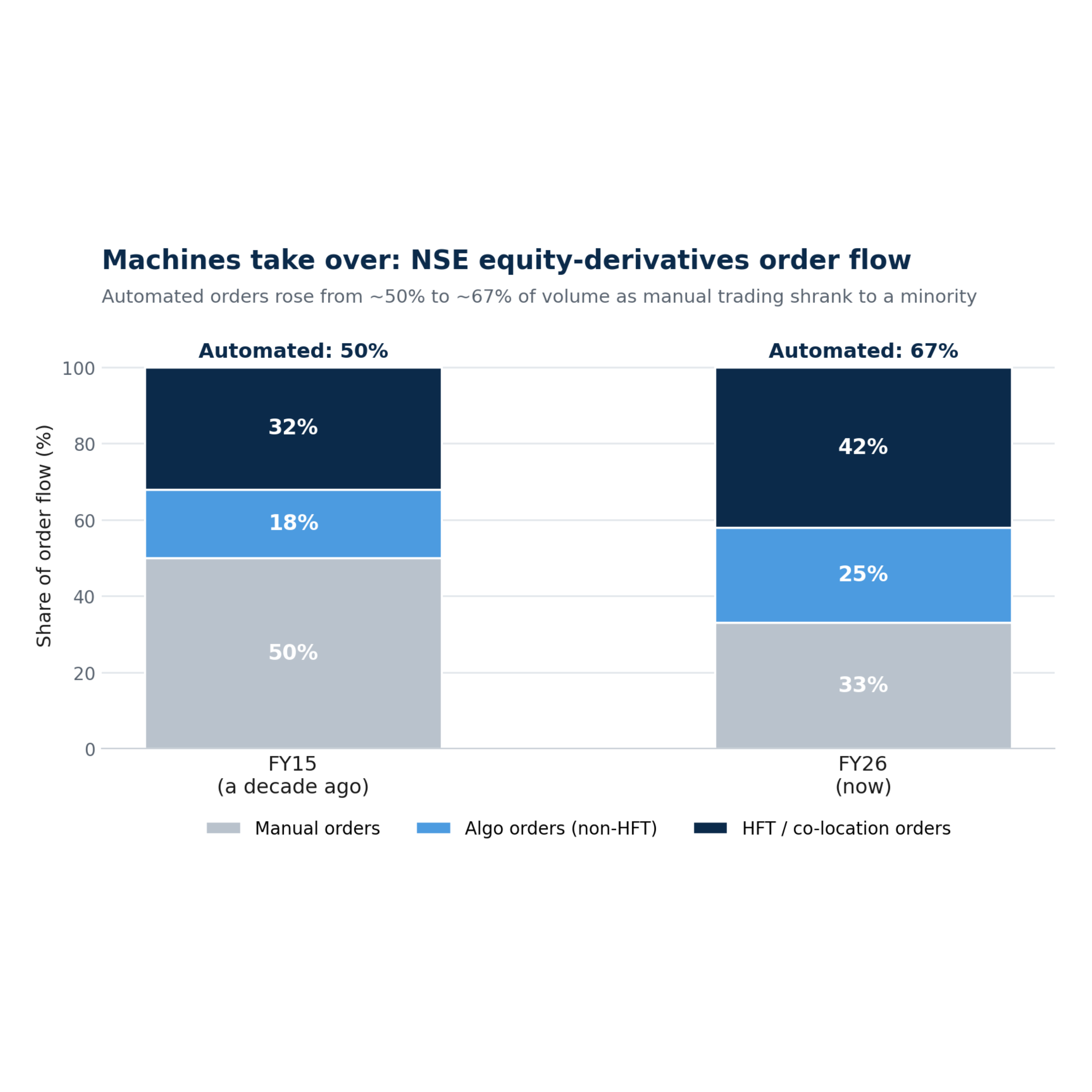
Share of NSE equity-derivatives order flow. Algo-vs-manual totals (~50% → ~67%) reflect NSE Market Pulse data; the HFT / co-location share is indicative, based on industry reporting that proprietary and high-frequency desks drive the bulk of automated volume while retail algo use remains in single digits.
Much of that growth is now powered by AI tools once reserved for institutional desks. Over the last three years, retail participation on the NSE has more than doubled, active Demat accounts have hit a new all-time high of over 4.2 crore in 2026, and technology once available only to professional desks is now within reach of individual traders through consumer-grade platforms. Indian retail traders increasingly have access to the same AI-powered analysis institutions have used for years, with machine-learning models processing price history, volumes, financial statements and news sentiment to surface patterns humans might miss.
A wave of platforms has fueled the trend. No-code services such as Streak let users build, backtest and deploy automated strategies without writing code, while other AI tools recommend options strategies and market-mood indicators. Newer tools like Trade Brains' Portal AI use natural language processing, letting investors type prompts such as "analyse the financial health of HDFC Bank" and receive structured fundamental analysis in return.
But rapid adoption has brought rising scrutiny. SEBI's retail algorithmic trading framework was introduced to close gaps that emerged as broker APIs and third-party algo solutions became widely accessible to ordinary investors. Under the framework, which carried an April 2026 compliance deadline, algo providers must register with the NSE and BSE, pass technical audits with partner brokers, and obtain Research Analyst registration if they offer "black box" strategies whose logic is hidden from users. The rules form part of a broader 2026 overhaul that also tightened stockbroker regulations and futures-and-options norms.
Oversight extends to AI specifically. SEBI has issued 'Responsible Usage of AI' guidelines for intermediaries, signalling tighter scrutiny of AI in financial markets. Firms and advisers must take full legal responsibility for AI-generated advice, cannot blame algorithmic errors, and must disclose to clients how AI is being used.
The message from India's market is a now-familiar balance: AI is leveling the playing field between retail and institutional investors at unprecedented speed, but the era of "set it and forget it" automation is being firmly bounded by accountability rules. As the next wave of AI-driven tools arrives, India's regulators appear determined that innovation will not outrun investor protection.
(Reporting, not investment advice.)