One Number, Everyone Reacts: The Repo Rate, Explained Without the Jargon
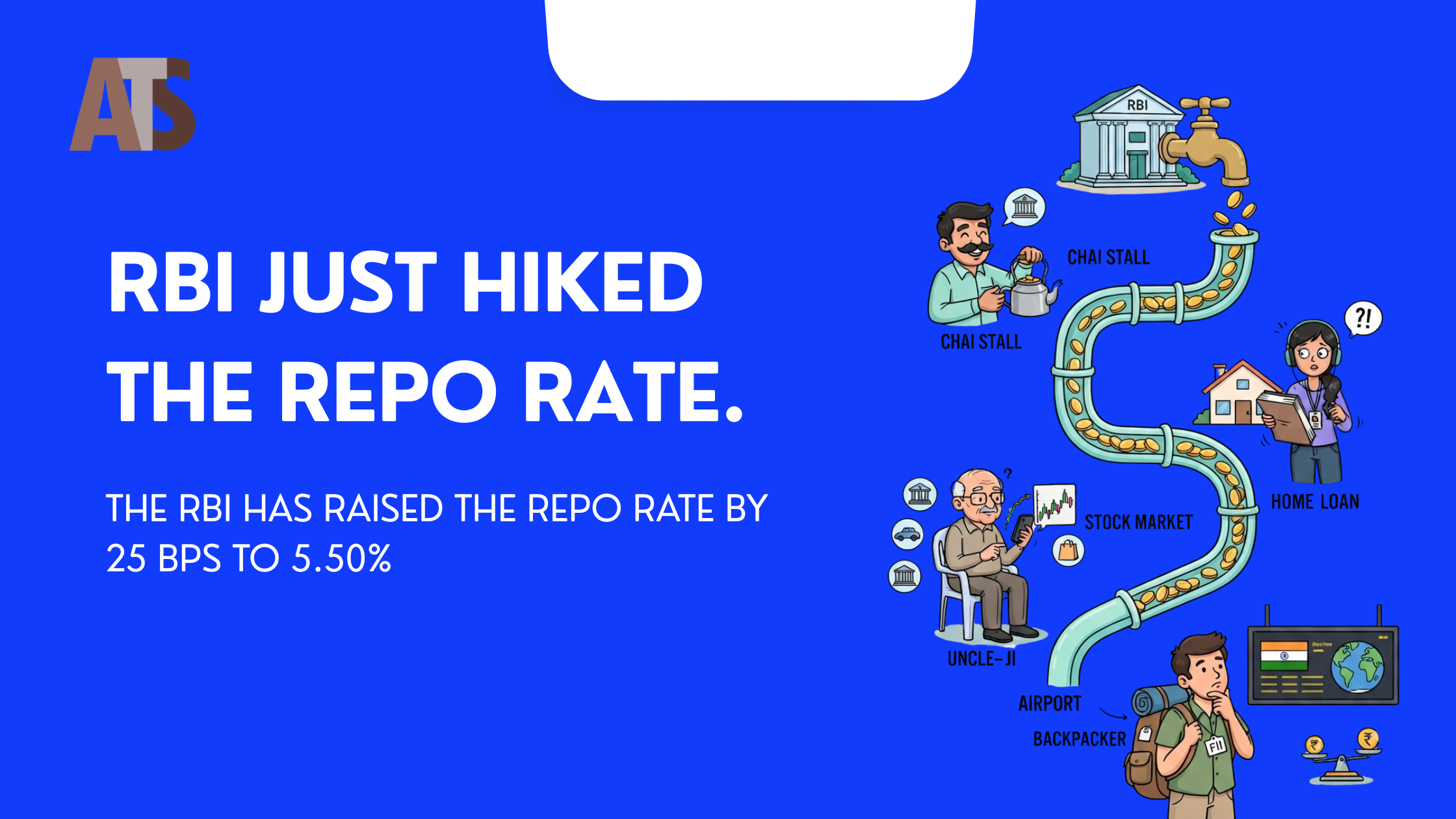
Every couple of months, India's financial news turns into a ritual. A group of six people in Mumbai announce a single number, and suddenly TV anchors are shouting, bank stocks are twitching, and your uncle's WhatsApp group has strong opinions.
That number is the repo rate. It looks like a tiny decimal. It quietly shapes your EMI, your fixed deposit, your mutual fund returns and even where a fund manager in London decides to park money.
Let's follow that one number through four everyday scenes.
Scene 1: The Chai Stall (What is the repo rate?)
Picture Raju, the chai-wala on the corner. He buys sugar and milk in bulk, then sells you a cup for ₹15. If Raju runs short of cash for stock, he borrows from a wholesaler and pays a little interest for the privilege.
Now swap Raju for a commercial bank, and the wholesaler for the Reserve Bank of India (RBI).
Banks sometimes need short-term cash. They borrow it from the RBI by pledging government securities as collateral. The interest rate they pay for that borrowing is the repo rate, short for "repurchase option rate". The bank sells securities to the RBI and agrees to buy them back later at a slightly higher price. The difference is the interest.
In plain words: the repo rate is the rate at which banks borrow from the RBI. Think of the RBI as the bank for banks. Even banks have to say, "Bhaiya, thoda udhaar de do."
Where is the repo rate today?
On 7 October 2026, the RBI's Monetary Policy Committee raised the repo rate by 25 basis points to 5.50%, according to live reports of the policy announcement. It had held the rate at 5.25% at its August meeting. Around the repo rate sits a "corridor": the Standing Deposit Facility rate (what banks earn parking spare cash with the RBI) below it, and the Marginal Standing Facility and Bank Rate above it. The corridor shifts along with the repo rate.
How did we get here? The rate started 2025 at 6.50%. The RBI then ran a rate-cut cycle, trimming a cumulative 125 basis points to reach 5.25%, and held it there through mid-2026. This hike is a change of direction. In the weeks before the meeting, analysts pointed to pressure from crude oil prices, a weaker rupee and inflation broadening beyond headline numbers, and some, including SBI Research, had forecast a 25 bps hike.
A quick word on "basis points": 1 basis point (bps) is 0.01%. So a 25 bps move means the rate changes by a quarter of a percentage point.
The Monetary Policy Committee meets roughly every two months, so the next decision is expected in December. For the official wording, see the RBI's press release.
Scene 2: The Auto Meter (Why does your loan care?)
Tanvi is a software engineer in Bengaluru. She has a home loan, a dream of a car, and a deep emotional relationship with her EMI.
Here is the chain reaction she lives through:
RBI changes the repo rate → banks' cost of funds changes → lending rates change → Tanvi's EMI changes.
This link is tighter than it used to be. Since 2019, most new floating-rate retail loans, including home, auto and personal loans, are linked to an external benchmark such as the repo rate. When the repo rate falls, the interest rate on these loans usually falls with it. When it rises, so does your rate.
What does this look like in rupees?
Take a ₹50 lakh home loan over 20 years:
| Interest rate | Approx. monthly EMI |
|---|---|
| 8.50% (before the hike) | ₹43,400 |
| 8.75% (after a 25 bps hike) | ₹44,200 |
A quarter-point hike adds roughly ₹800 a month to the EMI, or nearly ₹2 lakh over the life of the loan. Small number, big consequences. (These are illustrative figures. Your actual EMI depends on your lender, spread and tenure, and repo-linked loans typically reset within a quarter.)
The auto-rickshaw version: Tanvi says, "Bhaiya, meter se chalo." The meter, like her EMI, moves with the rate. Same road, same destination, different fare.
And if you are a saver?
The same logic works in reverse for fixed deposits. When rates rise, banks tend to raise FD rates too, though usually more slowly. Tanvi's loan gets costlier while her retired father's FD gets more attractive. That is the trade-off in monetary policy: borrowers and savers rarely cheer at the same time.
Scene 3: The Cricket Pitch (Why should investors care?)
Uncle-ji is retired, runs the family "Market Gyan" WhatsApp group, and has predicted fourteen of the last three market crashes.
But even Uncle-ji understands the basic idea. The repo rate is like the pitch condition in cricket. Change the pitch, and the whole game plan changes.
Here is the simple chain:
- Rates fall. Money becomes cheaper to borrow. Companies can fund expansion at lower cost, consumers spend more on homes and cars, and future profits look more valuable today. That generally supports stocks.
- Rates rise. Borrowing gets costlier. Growth can slow, company interest bills go up, and safer options like bonds and deposits start looking more attractive compared with stocks.
Markets don't panic when rates move. They reassess. Okay, sometimes they panic a little first.
Rate-sensitive sectors to watch
- Banks and NBFCs: their margins and loan demand respond directly to rate changes.
- Real estate: buyers depend on home loans, so cheaper credit tends to lift demand.
- Auto: most vehicles are financed, so EMIs matter a lot.
- Consumer durables and retail: big-ticket purchases often run on EMIs too.
Bonds, cash and stocks
Bond prices and interest rates move in opposite directions. When rates fall, existing bonds paying higher interest become more valuable. When rates rise, they lose some value. That is why debt fund investors also keep an eye on policy announcements.
One caution: the market often moves before the announcement, because everyone is trying to guess the decision in advance. What matters is not just the rate itself but whether it matched expectations, and what the RBI says about the future (its "stance").
Scene 4: The Airport Check-in (Why do foreign investors care?)
Meet Backpacker Bobby, a global fund manager with a rucksack tagged FII / FPI (Foreign Institutional Investor / Foreign Portfolio Investor). Bobby isn't running anywhere. He is standing at a departure board, comparing destinations.
When Bobby decides where to allocate money, he asks three questions:
- Rates: What are interest rates in India compared with the US, Europe and other emerging markets?
- Returns: What kind of growth and earnings can Indian companies deliver?
- Rupee: What might happen to the currency? A strong return can shrink if the rupee weakens against his home currency.
The repo rate feeds into all three. It signals how the RBI sees growth and inflation, it affects the yield on Indian bonds, and it influences currency expectations.
Notice what this is not: a stampede for the exit. Foreign investors reassess allocations as conditions change. Sometimes they add to India, sometimes they trim, and often they simply wait. Global money watches India as closely as India watches global money.
The Big Picture: One Number, Many Reactions
| Who | What they watch | Why it matters |
|---|---|---|
| The bank | Cost of borrowing from RBI | Sets the base for its lending and deposit rates |
| The borrower | EMI | Monthly budget |
| The saver | FD rates | Income from savings |
| The investor | Sector and valuation impact | Portfolio returns |
| The foreign fund | Rates + returns + rupee | Where to allocate global capital |
What to Do With This Knowledge
- Home loan borrowers: after a hike, check how your lender will adjust, through a higher EMI or a longer tenure. If you can, a small prepayment helps offset it.
- Savers: if rates are rising, a short-term deposit or a short wait may fetch a better rate than locking in a long FD today.
- Investors: don't trade on a single policy headline. Look at the stance, the inflation and growth outlook, and how much was already priced in.
- Everyone: treat the repo rate as context, not as a prediction machine.
Quick FAQ
Is the repo rate the same as the interest rate I pay on my loan? No. It is the rate banks pay the RBI. Your loan rate is the repo rate (or another benchmark) plus the bank's spread.
Who decides the repo rate? The six-member Monetary Policy Committee, chaired by the RBI Governor, decides it.
What is the reverse repo rate? The rate at which the RBI borrows from banks. In practice, the Standing Deposit Facility now serves as the floor of the rate corridor.
Does a rate cut always mean cheaper loans immediately? Not instantly. Transmission takes time, and banks adjust loan and deposit rates at different speeds.
The Takeaway
The repo rate is a small number with a long reach. It starts at the RBI, passes through the banks, lands in your EMI, shapes how markets value companies, and quietly enters the calculations of investors around the world.
Next time the headline says "RBI holds rates" or "RBI cuts rates", you won't just see a number. You'll see Raju's chai stall, Tanvi's auto meter, Uncle-ji's cricket pitch and Bobby's boarding pass.
This article is for educational purposes and is not financial advice. Rates and policy decisions change, so always check the RBI's website for the latest figures.