India's Reservoir Storage Falls to 71.84%: Drought, Water Shortage and Market Impact (October 2026)
Data as of October 1, 2026 (Maharashtra and Rajasthan: October 5, 2026)
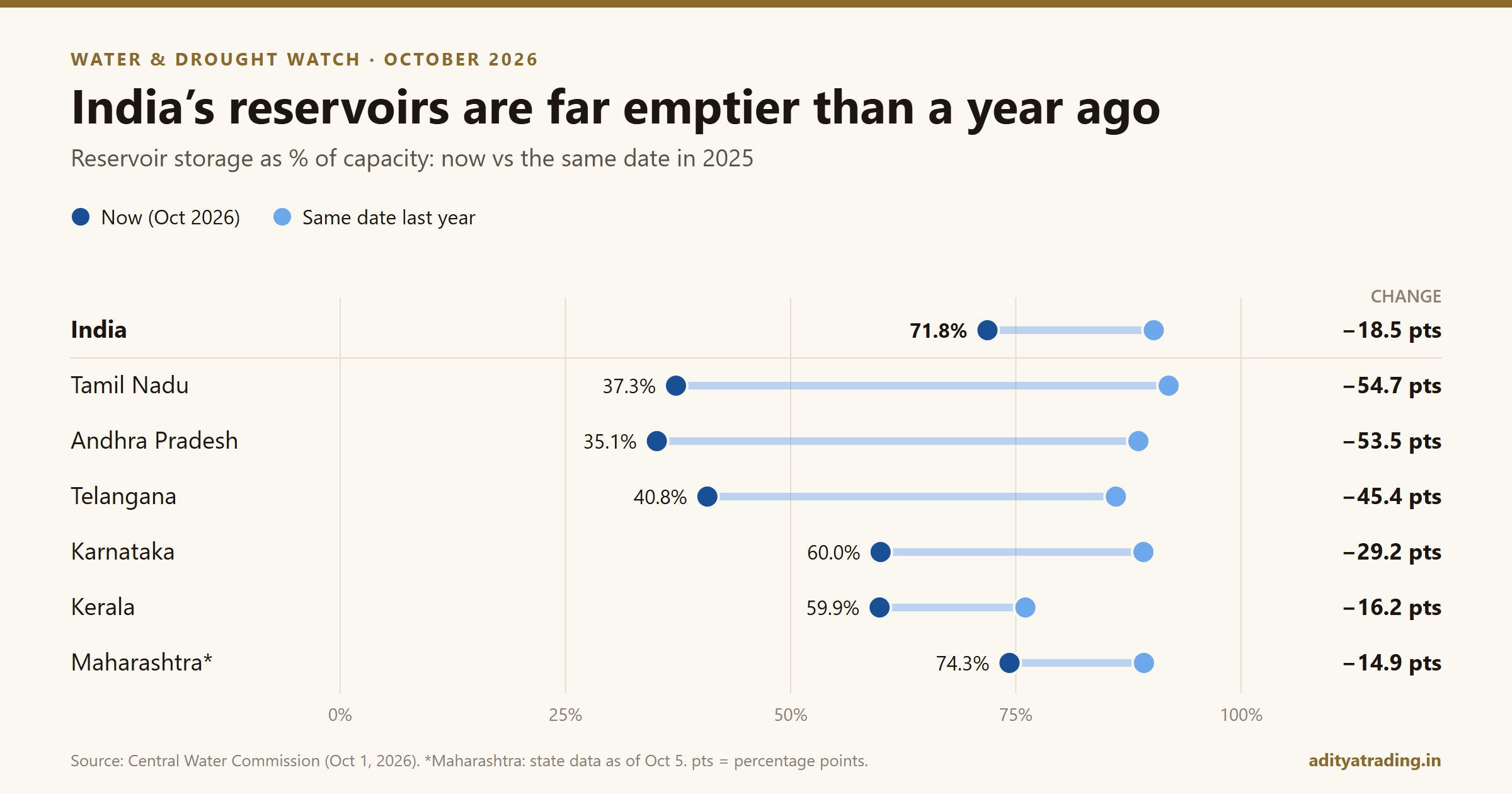
India is heading into the post-monsoon months with far less water in the bank than it had a year ago. The country's major reservoirs held 71.84% of their storage capacity on October 1, 2026, according to Central Water Commission (CWC) data. On the same date last year they were 90.31% full, and the normal level for this time of year is 81.79%. That means India has roughly a fifth less water in its major reservoirs than it did twelve months ago, and is about 10 percentage points below where it usually stands at the end of the monsoon.
The national number hides a much sharper story at the state level. In Andhra Pradesh, Tamil Nadu and Telangana, storage is less than half of what it was a year ago. Maharashtra and Rajasthan, which have already announced drought relief, are seeing deep shortfalls in regions such as Marathwada and Jodhpur. With the southwest monsoon over after a weak season, these reservoirs now have to supply farms, cities and power plants until the next monsoon arrives in June 2027.
In this article we break down the latest data state by state, explain why the reservoirs fell so sharply, and look at what the water shortage means for farmers, inflation, interest rates and the stock market.
Key takeaways
- All-India storage: 71.84% of capacity on October 1, 2026, against 90.31% a year ago and a normal of 81.79%.
- The south is worst hit: Andhra Pradesh (35.14% vs 88.60% last year), Tamil Nadu (37.27% vs 91.96%) and Telangana (40.75% vs 86.10%).
- Drought is spreading: Maharashtra has declared drought in 265 of 358 talukas, Andhra Pradesh in 388 mandals and Karnataka in 124 taluks. Telangana has identified severe drought conditions in 320 mandals, and Rajasthan is running field surveys in 117 tehsils.
- The root cause: the 2026 southwest monsoon ended about 12.6% below its long-period average, the weakest since 2015, as El Niño took hold.
- The impact goes beyond farms: hydropower output is falling, the RBI has raised the repo rate to 5.50% with the weak monsoon among its concerns, and rural demand indicators such as tractor sales have softened.
- The next swing factor is the northeast monsoon (October to December), which matters most for Tamil Nadu and coastal Andhra Pradesh.
India's reservoir storage at a glance
The table compares current storage with the same date last year and with the normal level. The CWC defines "normal" as the average storage on the same date over the last ten years.
| State / region | Storage now | Same date last year | Normal level | Change vs last year |
|---|---|---|---|---|
| India | 71.84% | 90.31% | 81.79% | -18.47 pts |
| Andhra Pradesh | 35.14% | 88.60% | 71.85% | -53.46 pts |
| Tamil Nadu | 37.27% | 91.96% | 66.00% | -54.69 pts |
| Telangana | 40.75% | 86.10% | 78.95% | -45.35 pts |
| Kerala | 59.88% | 76.06% | 69.75% | -16.18 pts |
| Karnataka | 59.98% | 89.16% | 80.42% | -29.18 pts |
| Rajasthan* | 61.93% | — | — | — |
| Maharashtra* | 74.29% | 89.22% | — | -14.93 pts |
*Maharashtra and Rajasthan figures are state data as of October 5, 2026. All other figures are as of October 1, 2026. "pts" means percentage points. A dash means no comparable figure was available.
Three things stand out:
- The crisis is concentrated in the south. Andhra Pradesh, Tamil Nadu and Telangana have each lost 45 to 55 percentage points of storage compared with last year. They are working with well under half the water they had in October 2025.
- This is not just a tough comparison with a good year. Storage in 2025 was unusually high, which exaggerates the year-on-year fall. But even against the ten-year normal, Telangana is 38 points short, Andhra Pradesh almost 37 points short and Tamil Nadu nearly 29 points short. That is a genuine deficit.
- State averages hide local emergencies. Maharashtra and Rajasthan look moderate overall, but Marathwada and Jodhpur are in serious trouble, as the regional data below shows.
Why are reservoirs so low? A weak, El Niño-hit monsoon
India's reservoirs are filled almost entirely by the June to September southwest monsoon. In 2026 the monsoon delivered about 759 mm of rain against a long-period average (LPA) of about 869 mm, based on India Meteorological Department (IMD) figures reported at the end of the season. That is roughly 87% of normal, a shortfall of about 12.6%, and the weakest monsoon since 2015. IMD classifies any season below 90% of the LPA as "deficient".
The season went wrong early. The monsoon reached Kerala on June 4, a few days late, and June ended about 40% short of normal rainfall. July brought some recovery, but rain stayed patchy, with long dry spells in key farming regions. Marathwada, for example, went through a dry spell of about 45 days in the middle of the crop season.
The main driver is El Niño, a periodic warming of the central and eastern Pacific Ocean that tends to weaken the Indian monsoon. IMD had forecast below-normal rainfall before the season began, and its extended-range outlook of October 1 said strong El Niño conditions were prevailing and expected to strengthen further in the coming months.
Why the timing of rain matters as much as the total
A 12 to 13% national shortfall does not sound catastrophic on its own. The damage comes from how unevenly the rain fell. When rain arrives in short, heavy bursts separated by long gaps, much of it runs off instead of recharging soil and groundwater, and crops wilt during the dry weeks. Some regions also fared far worse than the national average. Andhra Pradesh received 53% less rain than normal between June and August, while Pali, Jaisalmer and Jalore in Rajasthan were each more than 50% short for the season.
State by state: where the water stress is worst
Andhra Pradesh: the steepest fall in the country
Andhra Pradesh's reservoirs held just 35.14% of capacity on October 1, compared with 88.60% a year ago and a normal of 71.85%. That is about 60% less water than last year and less than half the normal level.
The state government has declared drought in 388 of its 688 mandals across 21 districts for the kharif season. Of these, 283 mandals are classed as severely affected and 105 as moderately affected. The government acted before the usual October 31 deadline, citing a 53.4% rainfall deficit between June and August (197.6 mm against a normal of 424.3 mm), long dry spells, low reservoir levels, falling groundwater and poor soil moisture.
Rayalaseema and southern Andhra are the worst hit, with heavy losses in paddy, maize and coconut. Officials have been told to assess crop damage and prepare for drinking water shortages, including tanker supply where needed. The opposition YSRCP has criticised the timing of the declaration and the exclusion of Nellore district.
Tamil Nadu: the delta waits on Mettur and the northeast monsoon
Tamil Nadu's storage was 37.27% on October 1, against 91.96% a year ago and a normal of 66%. That is the largest year-on-year drop of any state in the data, at almost 55 percentage points.
The pressure is most visible in the Cauvery delta. The Mettur dam, which irrigates the delta's paddy fields, opened for irrigation only on September 1 this year instead of the customary June 12, because it did not have enough water earlier in the season. By late September its level had fallen to about 80.5 feet, against a full level of 120 feet, as releases for samba paddy ran far ahead of inflows. Farmers have been advised to switch to medium-duration paddy varieties and water-saving methods such as direct seeding. Some tail-end farmers reported that canal water had still not reached their fields weeks after the dam opened.
Tamil Nadu also depends on water released by Karnataka under the Cauvery sharing arrangement, and with Karnataka in drought too, that dispute has flared again. The silver lining is that Tamil Nadu gets most of its rain from the northeast monsoon (October to December). IMD has indicated that this season is likely to be normal over Tamil Nadu, with onset expected around the third week of October, although north interior districts may receive below-normal rain.
Telangana: a political fight over declaring drought
Telangana's reservoirs were at 40.75% on October 1, compared with 86.10% last year and a normal of 78.95%, which is less than half of last year's level. The state received 615.5 mm of rain during the southwest monsoon against a normal of 740.6 mm, a shortfall of about 17%, and 18 of its 33 districts recorded deficient rainfall.
Opposition parties, led by the BRS, have demanded that the government declare drought. They argue that the crisis is not only about El Niño but also about the state's failure to make full use of available Krishna and Godavari water. Farmers have protested against power cuts that disrupt borewell irrigation.
On October 6, a preliminary assessment identified severe drought conditions in 320 mandals across 18 districts. The state cabinet has decided to seek drought assistance from the Centre, Chief Minister Revanth Reddy is scheduled to review the situation with ministers on October 12, and officials have been asked to prepare a comprehensive drought report by the end of October.
The stress shows up in smaller water bodies too. As of October 3, about 17,677 of the roughly 21,500 tanks monitored in the state were less than half full. Heavier use of borewells pushed Telangana's peak power demand to a record of about 19,543 MW in September.
Karnataka: 124 drought-hit taluks and a Cauvery squeeze
Karnataka's storage stood at 59.98% on October 1, compared with 89.16% a year ago and a normal of 80.42%. The state received about 30% less rain than normal between June 1 and August 26, and south interior Karnataka, home to the Cauvery basin reservoirs, was about 41% short.
The government declared 101 taluks drought-affected on August 27 and added 23 more in September, taking the total to 124 taluks, with another 53 taluks under field verification. In late September the four main Cauvery basin reservoirs (KRS, Kabini, Hemavathi and Harangi) together held about 49.8 TMC (thousand million cubic feet), or roughly 48% of their capacity.
Karnataka says it needs about 29 TMC for drinking water, 10 TMC for environmental flows and 23.4 TMC for standing crops. That adds up to about 62 TMC, more than the water available, even as the Cauvery Water Regulation Committee has directed the state to keep releasing water to Tamil Nadu. Expect the inter-state dispute to stay in the news for as long as storage remains this low.
Kerala: lower storage in a state that runs on hydropower
Kerala's reservoirs were at 59.88% of capacity, compared with 76.06% a year ago and a normal of 69.75%. The gap is smaller than in neighbouring states, but it matters because Kerala relies heavily on hydroelectric dams for its own power generation. Lower storage going into the dry months can mean more expensive power purchases from outside the state.
Maharashtra: Marathwada and Vidarbha bear the brunt
Maharashtra's overall storage was 74.29% on October 5, compared with 89.22% on the same date last year. The state average looks moderate, but the regional picture is much worse:
| Region (division) | Storage now | Same date last year | Change |
|---|---|---|---|
| Chhatrapati Sambhajinagar (Marathwada) | 43.55% | 82.96% | -39.41 pts |
| Amravati (Vidarbha) | 62.92% | 85.87% | -22.95 pts |
| Nagpur (Vidarbha) | 72.02% | 89.08% | -17.06 pts |
| Maharashtra (overall) | 74.29% | 89.22% | -14.93 pts |
Marathwada, covered by the Chhatrapati Sambhajinagar division, is working with roughly half the water it had a year ago. It is one of India's most drought-prone regions and depends heavily on reservoirs for both drinking water and irrigation.
In late September the state government declared drought in 265 of its 358 talukas, about 74% of the state, after an Agriculture Commissioner's report found drought-like conditions in 32 districts. Agriculture officials estimate that at least a quarter of standing crops in Marathwada were damaged after the 45-day dry spell, with soybean, maize and cotton among the worst hit.
Relief announced so far includes land revenue concessions, restructuring of crop loans and deferred loan recovery, concessions on electricity bills for farm pumps, more work under the Employment Guarantee Scheme, and waiver of exam fees for students. A separate government order on cash compensation for crop losses is expected once field assessments (panchnamas) are complete.
Rajasthan: Jodhpur's reservoirs nearly empty
Rajasthan's overall storage was 61.93% on October 5. The most worrying number is in Jodhpur, where storage was just 15.72% against 80.25% a year ago, about one-fifth of last year's level.
Reports put the state's monsoon shortfall at roughly 17 to 22% below normal, but the western districts were hit far harder: Pali was about 58% short, Jaisalmer 54% and Jalore 50%. The Revenue Department has ordered a girdawari (a field-level crop survey) in 117 tehsils to assess drought conditions. Pali, Jalore and Jaisalmer are reported to be the worst affected, with Jodhpur, Banswara, Bhilwara, Balotra, Rajsamand, Udaipur and Sirohi also affected.
The state has announced relief for Barmer, Balotra, Jaisalmer and other areas, including fodder depots for livestock, and district collectors can approve contingency relief works of up to ₹1 crore. Kharif crops such as bajra, moth bean, soybean, green gram (moong) and other pulses have suffered heavy damage.
Why low reservoir levels matter beyond the farm
Reservoir water does three big jobs: irrigation, drinking water and electricity. A shortfall in October affects all three for the next eight months.
1. The rabi season is now the biggest risk
The kharif (monsoon) crop is largely rain-fed, and sowing held up better than the rainfall suggested. According to the RBI and SBI Research, total kharif acreage was only marginally below last year. Paddy area fell by about 16 lakh hectares, while pulses such as urad, moong and tur, and millets such as bajra and jowar, gained area.
The rabi (winter) crop is a different story. Wheat, chana (chickpea), mustard, rabi jowar and rabi paddy depend heavily on stored water and groundwater. Low reservoirs in October therefore translate directly into fewer irrigated rabi acres, especially in Marathwada, north Karnataka, Telangana and Andhra Pradesh.
The Centre has already lowered its 2026-27 foodgrain production target to 373.93 million tonnes, about 2.63 million tonnes below actual 2025-26 output of 376.56 million tonnes, citing El Niño. Agriculture Minister Shivraj Singh Chouhan has said kharif output will not fall significantly, but the RBI Governor has flagged the rabi season as a risk.
2. Drinking water and the summer of 2027
Reservoirs that start the dry season this low leave little room for error before the next monsoon. Andhra Pradesh is already preparing tanker supply plans, Maharashtra has told officials to plan across all 358 talukas rather than only the 265 declared ones, and Rajasthan officials expect the water crisis to worsen next summer. Towns and cities that draw on these reservoirs could face supply cuts between March and May 2027 if the northeast monsoon and winter rains do not help.
3. Less hydropower, more coal
Hydropower generation fell about 12% year on year in the first three weeks of September, on course for a fifth straight month of decline, while coal-fired generation rose about 18% over the same period. In early October, reports pointed to a deepening power deficit as weak wind generation added to the hydro slump. The result is greater dependence on coal, likely higher coal imports in the October to December quarter, and upward pressure on spot power prices. Farm power demand is rising as well, as farmers pump more groundwater. Telangana's record September peak is one example.
4. The human cost
Crop losses cut farm incomes and the wages of agricultural labourers, and drought years often push more people to migrate in search of work. Social risks rise too. Maharashtra's Women and Child Development Minister Aditi Tatkare has warned that child marriages tend to increase during droughts. She has directed officials to work directly with families in drought-hit and migration-prone areas, ensure anganwadi centres in tanker-dependent villages get enough water, and prepare hostels for the children of migrant workers. Child marriage can be reported on the national Child Helpline, 1098.
What it means for inflation, interest rates and markets
Food inflation and the RBI's rate hike
On October 7, 2026, the Reserve Bank of India's Monetary Policy Committee raised the repo rate by 25 basis points to 5.50%, its first hike since February 2023, and changed its stance from neutral to "calibrated tightening". The RBI cited several factors, including the conflict in West Asia and high global commodity prices, but the monsoon featured prominently. Governor Sanjay Malhotra described the southwest monsoon as deficient and uneven, warned that it could hurt the rabi season and rural demand together with strong El Niño conditions, and said food price pressures were becoming broader.
The RBI raised its 2026-27 CPI inflation forecast to 5.2% from 5.0% and expects inflation of about 6.0% in the October to December quarter. Headline CPI inflation was 4.82% in August. For borrowers, a higher repo rate means home, auto and business loan rates may edge up. For savers, fixed deposit rates may improve. (New to the repo rate? Read our explainer, the repo rate explained without the jargon.) The next MPC meeting is scheduled for December 2 to 4, 2026, and food prices over the next two months will weigh heavily on that decision.
Rural demand: early signs of a slowdown
Rural spending tracks farm incomes, and the first signals are already visible. Mahindra & Mahindra's domestic tractor sales fell 23% year on year in September 2026, and Escorts Kubota reported a decline of about 16.7%. These numbers need context. Mahindra pointed out that the festive season fell in October this year, against September last year, and that September 2025 was a high base boosted by GST rate cuts. Its domestic tractor sales for the year so far are still up about 6%. October and November data will be a cleaner test of rural demand.
Rural markets also account for a large share of consumer goods sales. Industry estimates put the figure at roughly 30 to 45% of revenue for several large FMCG companies. In past drought years, rural households have generally kept buying essentials but cut back on discretionary items, switched to smaller packs or cheaper brands, and postponed big purchases such as two-wheelers.
Sectors to watch
The table below summarises how the water shortage can feed into different parts of the market. It is a framework for following the story, not a list of recommendations.
| Sector | How the drought can affect it | What to track |
|---|---|---|
| FMCG and rural consumption | Lower farm incomes can slow volume growth, especially for discretionary and premium products | Rural volume commentary in quarterly results, rural wage data |
| Tractors, two-wheelers and farm equipment | Purchases are often postponed in drought years | Monthly sales figures, festive-season retail data |
| Fertilisers, seeds and crop protection | Rabi demand depends on how much land can be irrigated | Weekly rabi sowing data, reservoir levels in key rabi states |
| Power utilities and coal | Lower hydro output raises reliance on thermal power and coal | Monthly generation mix, coal stocks at power plants, power exchange prices |
| Banks, NBFCs and microfinance lenders | Crop loan restructuring and deferred recovery in drought districts can slow collections | Asset quality and collection efficiency in rural loan books |
| Sugar | Maharashtra and Karnataka are major cane growers, and water stress can hurt cane yields and future planting | Cane area and crushing estimates for the coming season |
| Pumps and micro-irrigation | Drought years tend to increase reliance on borewells and water-saving irrigation | Order inflows, state subsidy releases |
Agricultural commodities
Crop losses in specific regions can tighten the supply of some commodities, but the national picture matters too. Pulses acreage rose nationally even as Rajasthan and Maharashtra suffered heavy losses, so price moves will depend on final yields rather than headlines. Bajra, moth bean and soybean in Rajasthan, and soybean and cotton in Maharashtra, are the most exposed crops. If you follow agricultural commodities, our commodity trading guide explains how these markets work.
What to watch in the coming weeks
- Northeast monsoon onset (mid to late October): a normal season would help Tamil Nadu and coastal Andhra Pradesh, while a weak one would deepen the southern shortfall.
- Weekly CWC reservoir bulletins (every Thursday): watch whether storage stabilises or keeps falling.
- Drought decisions: Telangana's ministerial review on October 12 and its full report due by the end of October, Maharashtra's order on cash compensation, and the results of Rajasthan's girdawari.
- Rabi sowing data (from late October): the clearest signal of how much the water shortage will cost farm output.
- Inflation data: monthly CPI releases ahead of the RBI's December 2 to 4 policy meeting.
- Monthly sales and company results: October tractor, two-wheeler and FMCG numbers will show whether the September slowdown was about timing or the start of a trend.
The bottom line
India's reservoirs ended the monsoon about 18 percentage points emptier than last year and about 10 points below normal, and the shortfall is far deeper in Andhra Pradesh, Tamil Nadu, Telangana, Marathwada and western Rajasthan. Because this water has to last until June 2027, the effects will unfold over months, not days: in rabi output, food prices, drinking water supply, power generation and rural spending. The northeast monsoon gives the south one more chance to recover, but with El Niño expected to strengthen, it is prudent to plan for a tight water year. For investors, this is a story to track through the data rather than react to in a single trading session.
Sources: Central Water Commission, India Meteorological Department, Reserve Bank of India, Business Standard, Down To Earth, The News Minute, The Hans India, Deccan Herald, Siasat, Free Press Journal, Bloomberg, Zee Business, Policy Circle.
Disclaimer: This article is for information and educational purposes only. It is not investment advice or a recommendation to buy, sell or hold any security. Data is taken from public sources as of the dates mentioned and may be revised. Investments in the securities market are subject to market risks. Read all related documents carefully before investing.