11. What is a Candlestick Chart?
A candlestick chart is one of the most widely used tools in technical analysis. It visually represents a stock’s Open, High, Low, and Close (OHLC) prices for a specific time period (like 5 minutes, 1 hour, 1 day, etc.) — all shown in a candle-shaped graphic.
“Each candlestick tells a story about price behaviour, market psychology, and trader sentiment — all in a single candle.”
Structure of a Candlestick
Each candle consists of two parts:
-
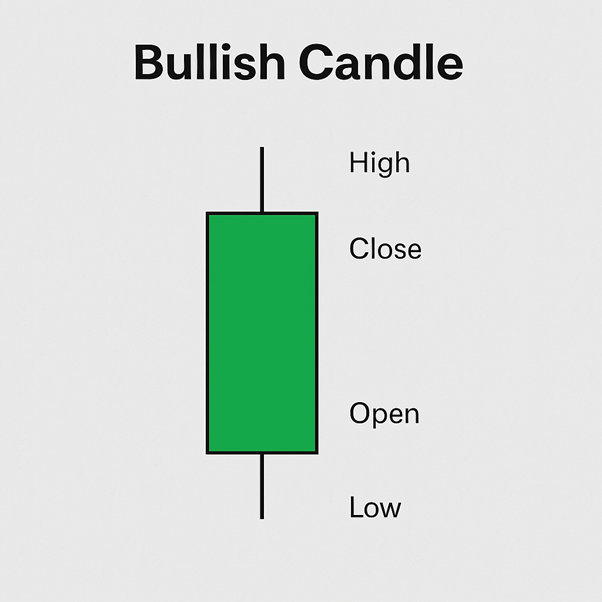
The Body (Rectangle)
- Represents the range between Open and Close prices
- Green/White Candle: Close > Open (Bullish)
- Red/Black Candle: Close < Open (Bearish)
-
The Wicks or Shadows (Thin Lines Above & Below)
- Upper wick = highest price
- Lower wick = lowest price
Visual Layout of a Candlestick
Bullish Candle (Price Closed Higher)
Bearish Candle (Price Closed Lower)

Timeframes for Each Candle
- Each candlestick represents one unit of time:
- Daily chart → 1 candle = 1 day
- 5-minute chart → 1 candle = 5 minutes
- Weekly chart → 1 candle = 1 week
Why Candlestick Charts Are Popular
| Feature | Benefit |
|---|---|
Candlestick vs Line Chart
| Line Chart | Candlestick Chart |
|---|---|
What Can You Learn from a Candle?
- Big green candle + high volume = Strong bullish momentum
- Small body + long wicks = Indecision (Doji-type candles)
- Long red candle after uptrend = Possible bearish reversal
- No wicks = Strong control by buyers/sellers in that timeframe
Common Single-Candle Signals
| Candle Pattern | Meaning |
|---|---|
These patterns become more meaningful at key support/resistance zones or after trends.
Key Takeaways
- A candlestick chart displays OHLC prices in a visual format.
- Candles can be bullish or bearish, depending on whether the price closed higher or lower.
- Wicks show extremes, while the body shows strength.
- Traders use candlestick charts to spot patterns, reversals, and trend continuation.
- Every candle gives valuable insight into price action and trader psychology.